Moving from San Francisco to Austin: 2026 Bay Area Guide
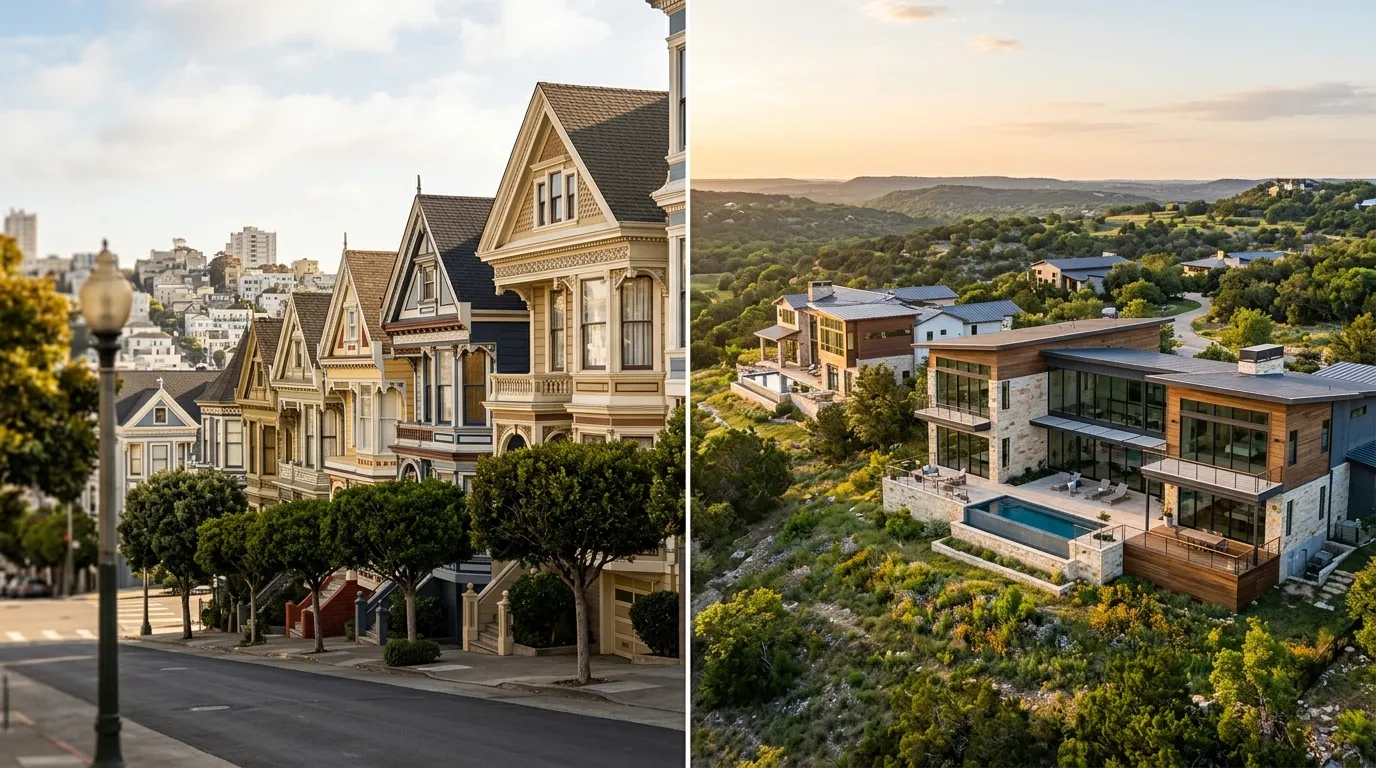
Moving from San Francisco to Austin in 2026 typically saves a Bay Area household $35,000–$45,000 per year in state and income-related taxes, while delivering 2–3x more home for the same purchase price. A $1.5 million budget that buys a 1,200 sq ft San Francisco condo buys a 3,500+ sq ft Westlake home with Hill Country views or a 5-bedroom new construction in Cedar Park. Bay Area tech transplants most commonly land in Cedar Park, Leander, Westlake, Bee Cave, and Lakeway — all within commuting range of the Parmer Lane tech corridor (Apple, Google, Meta, Oracle) and the Domain area.
William Zhang is an Austin-based real estate agent and relocation specialist with eXp Realty (TREC #811948) who works with Bay Area and San Francisco transplants every month. He helps tech workers, remote employees, and families navigate neighborhood selection, school district verification, and closing remotely without a trip to Austin.
The Short Version for Bay Area Buyers
- San Francisco median home price: ~$1.38 million. Austin median: ~$520,000. You get dramatically more home.
- No Texas state income tax. California’s top rate is 13.3%. For a $400K household, that’s roughly $37,000 back per year.
- Texas property taxes are higher (1.8–2.8%) than California’s Prop 13 rates, but on a much lower purchase price.
- Austin’s tech market is deep — Apple, Tesla, Google, Meta, Oracle, Dell, Samsung, AMD, and hundreds of startups.
- Car-dependent lifestyle. No equivalent to BART or Caltrain. Plan your home purchase around your commute route.
- Hot summers. June through September regularly exceed 100°F. The Bay Area’s marine layer does not exist here.
What $1.5 Million Buys: SF vs Austin
| Market | What $1.5M Buys in 2026 |
|---|---|
| San Francisco (proper) | ~1,200 sq ft condo, or small single-family in a fringe neighborhood |
| Palo Alto | Starter home, small lot, likely needs updating |
| San Jose / South Bay | 3-bed single-family in average condition |
| Austin — Westlake (Eanes ISD) | 4 bed/3.5 bath, ~3,500 sq ft, yard, Hill Country views |
| Austin — Cedar Park (Leander ISD) | Luxury 5-bed new construction in gated community |
| Austin — Leander | Brand-new 5,000+ sq ft home on a half-acre lot |
This is the most common reaction from Bay Area clients: they cannot believe what the same dollar amount buys in Austin. The comparison is not cherry-picked — it reflects actual 2026 market conditions.
The Tax Math for Bay Area Households
A household earning $400,000 per year moving from the Bay Area to Austin:
In California (Bay Area):
- California state income tax (effective ~9.3% at this income): ~$37,000/year
- Property tax on a $1.5M home (effective ~1.1% including local add-ons): ~$16,500/year
- Total state + property tax: ~$53,500/year
In Austin (buying a $700,000 home):
- Texas state income tax: $0
- Austin-area property tax on $700,000 (effective ~2.2%): ~$15,400/year
- Total state + property tax: ~$15,400/year
Annual savings: ~$38,000. And that figure does not include the mortgage difference between a $1.5M Bay Area loan and a $700K Austin loan — that gap is often another $4,000–$6,000 per month.
These are illustrative figures. Your specific picture depends on your filing status, deductions, business structure, and exact addresses. Always consult a Texas CPA before treating these numbers as firm.
Where Bay Area Transplants Actually Live in Austin
Based on patterns from relocation clients, here is where tech workers and Bay Area families typically land:
Cedar Park and Leander (most common for families): Top-rated Leander ISD schools, newer housing stock (2015–2026 construction), and direct access to the Parmer Lane tech corridor. Apple’s campus on Parmer Lane is a 20–30 minute drive from most of Cedar Park. Home prices range from $450,000–$900,000 for solid family homes. See the Cedar Park neighborhood guide for specifics.
Westlake (Eanes ISD, premium): If schools are the top priority and budget allows $900K+, Westlake offers the best public schools in the Austin area (Eanes ISD consistently ranks in the Texas top 5) combined with proximity to downtown. Tech workers at Google’s downtown campus find Westlake a 15–20 minute drive. See the Austin neighborhood guide for more.
Bee Cave and Lakeway: Good Lake Travis ISD schools, Hill Country feel, and a growing retail and restaurant base. Popular with Bay Area buyers who want more space and a slightly slower pace. Lakeway has a marina on Lake Travis if the water lifestyle matters. See the Lakeway neighborhood guide.
Domain-area neighborhoods (Northwest Hills, Great Hills, Arboretum): For tech workers who want a short commute to the Domain without moving to the suburbs, these established neighborhoods offer walkability to Domain retail and restaurants, with homes from $600,000–$1.2 million.
Round Rock: Leander ISD and Round Rock ISD both serve parts of Round Rock. Generally less expensive than Cedar Park, with solid schools and newer construction. See the Round Rock neighborhood guide.
Austin’s Tech Ecosystem for Bay Area Transplants
Austin’s tech employment base is substantial and growing. Major operations as of 2026:
- Apple: ~15,000 employees at the Parmer Lane campus, with a second campus under construction adjacent to it
- Google: Over 1.5 million sq ft of downtown office space, 4,000+ employees
- Meta: Half of Austin’s tallest skyscraper (now completed), major engineering presence
- Tesla: Gigafactory southeast of downtown (SH-130 corridor), largest employer in the area
- Oracle: Headquarters moved from Redwood City to Austin in 2020, large Lakeway campus
- Dell, Samsung, AMD, IBM: Long-standing major employers in Round Rock and North Austin
- Startup ecosystem: Capital Factory, a16z presence, active VC community
Salaries are typically 10–20% lower than Bay Area peers for the same role. The net take-home calculation changes significantly when you remove California income tax and cut your housing cost in half.
Austin Weather vs Bay Area: The Honest Version
This is the most underestimated adjustment for Bay Area transplants.
San Francisco’s average July high is 65°F. Austin’s average July high is 98°F, with stretches of 100°F+ lasting weeks. There is no marine layer, no fog, and no ocean moderation. The heat is dry to humid depending on the week and can feel relentless July through September.
The flip side: Austin spring (March–May) and fall (October–November) are genuinely beautiful — warm, mild, and green after rains. Winter is mild with average January highs in the upper 50s. Freezing events happen (Winter Storm Uri was 2021’s reminder) but are infrequent.
If you are moving from San Francisco specifically, visit Austin in August before committing. The heat is real and not everyone adjusts well to it.
Texas Property Taxes and the Homestead Exemption
Texas property tax rates in the Austin metro run from 1.8% to 2.8% of assessed value annually, depending on city and ISD. This is notably higher than California’s Prop 13-constrained rates, which often stay around 1.1% effective for longtime owners.
However, two things matter here:
- Austin homes cost 50–65% less than comparable Bay Area homes, so the dollar amount is often similar or lower even at a higher rate.
- The Texas homestead exemption reduces your assessed value by $100,000 for school district taxes and caps annual appraisal increases at 10% per year. You must file it yourself after closing — it is not automatic.
File the homestead exemption with your county appraisal district (Travis County, Williamson County, or Hays County depending on your address) as soon as you close. This is one of the first things William Zhang walks every relocation client through.
Schools in Austin for Bay Area Families
Bay Area families are often pleasantly surprised. Austin’s top school districts compete nationally:
- Eanes ISD (Westlake area): Consistently among the top districts in Texas and top 5% nationally. Small district, high funding.
- Lake Travis ISD (Lakeway/Bee Cave): Strong academics and athletics, growing district.
- Leander ISD (Cedar Park/Leander): Large district, nationally recognized high schools, strong STEM programs. Most Bay Area tech families with children end up in Leander ISD.
- Round Rock ISD: Solid performance, multiple nationally ranked high schools.
Verify the exact attendance zone for any specific address before purchasing. District boundaries in Texas can change, and neighborhood-level research matters.
More detail in the top Austin school districts guide.
Texas Driver’s License and Vehicle Registration
Texas requires new residents to obtain a Texas driver’s license within 90 days of establishing residency. You will also need to register your vehicles in Texas within 30 days, which requires a vehicle safety inspection first.
DPS (Department of Public Safety) appointment wait times in Austin can stretch 2–4 weeks. Schedule your appointment as soon as you have a Texas address — this is not something to leave until week 10. You will need your California license, proof of Texas residency (utility bill or lease), and Social Security number.
Vehicle registration is handled through the county tax assessor-collector’s office and can typically be done online once you have a Texas address and a passed inspection.
What to Do Before You Move
- Visit Austin in summer, not just spring or fall. If you only visit in October, you will get the best version of Austin weather and be shocked by August. Visit at least once during summer heat.
- Drive your commute at rush hour. Google Maps at noon tells you nothing about a 7:45am drive on MoPac. Test your actual commute route.
- Talk to a Texas CPA about your specific tax picture before assuming the move pays off — business structures, AMT, and deductions vary.
- Get pre-approved with a Texas lender. California loan officers often are not familiar with Texas closing norms — title companies instead of attorneys, different disclosure timelines.
- File the homestead exemption as soon as you close.
- Budget for property tax sticker shock in year two if you buy new construction — the first year’s assessment is often based on the unimproved lot, and year two jumps to full value.
Relocation Timeline: Bay Area to Austin
A typical Bay Area-to-Austin buyer timeline working with William Zhang:
- Months 1–2: Neighborhood research, virtual tours, pre-approval, school district narrowing
- Month 2–3: One in-person visit, live tours of shortlist homes, offer and contract
- Month 3–4: Inspection, appraisal, loan processing, coordinate California sale if applicable
- Month 4–5: Close, move, Texas license and registration within required windows
Remote buyers regularly close without returning to Austin between the initial visit and move-in day. Texas title companies support remote closings via mobile notary.
How William Zhang Helps Bay Area Transplants
William Zhang is a Bay Area relocation specialist with eXp Realty (TREC #811948) who has helped dozens of San Francisco and Bay Area families navigate the Austin market. His relocation process includes virtual neighborhood walk-throughs via video, in-person drive-throughs at rush hour to verify commute times, school district verification at the exact address level, cost-of-living modeling comparing your Bay Area total cost to your Austin projection, and coordination with Texas lenders, inspectors, and CPAs who work with relocation buyers regularly.
More on the general California-to-Austin picture in the moving from California to Austin guide. For family-specific neighborhood priorities, see best neighborhoods for families in Austin.
Frequently Asked Questions: San Francisco to Austin
The FAQs above cover the most common questions William Zhang hears from Bay Area transplants. For anything specific to your situation — school district verification, tax modeling, or neighborhood selection — reach out directly.
Ready to Talk About Your Move?
If you are thinking about moving from San Francisco or the Bay Area to Austin and want a straight conversation about what that actually looks like — homes, taxes, schools, neighborhoods — text or call William Zhang at (512) 766-3188 or get in touch. No pressure, no obligation.
Frequently Asked Questions
How much do you save moving from San Francisco to Austin?
A Bay Area household earning $400,000 per year typically saves $35,000–$45,000 annually by moving to Austin. The biggest single line item is California state income tax — Texas has none, so at a 9.3% effective rate on $400K, that's roughly $37,000 back in your pocket. Property taxes on a comparable Austin home are similar in dollar terms but the home costs 60–70% less, so the mortgage savings add up too.
What does $1.5 million buy in San Francisco vs Austin?
In San Francisco, $1.5 million buys a roughly 1,200 sq ft condo or a small single-family home in a fringe neighborhood. In Austin's Westlake area (Eanes ISD), the same $1.5 million buys a 4-bed/3.5-bath home around 3,500 sq ft with a yard and Hill Country views. In Cedar Park or Leander, you're looking at luxury 5-bed new construction on a half-acre.
Where do Bay Area tech workers live when they move to Austin?
The most common landing spots for Bay Area tech transplants are Cedar Park, Leander, Westlake (Eanes ISD), Bee Cave, Lakeway, and the Domain-area neighborhoods like Northwest Hills and Great Hills. Cedar Park and Leander combine top-rated schools (Leander ISD), newer housing stock, and proximity to the Parmer Lane tech corridor where Apple's campus sits.
Can I commute to Apple or Google Austin from Cedar Park or Leander?
Yes. Apple's campus is on Parmer Lane in North Austin, roughly a 20–30 minute drive from Cedar Park or Leander. Google occupies over 1.5 million square feet of office space in downtown Austin, about 30–40 minutes from Cedar Park. Tesla's Gigafactory is southeast of downtown, roughly 45–55 minutes from Cedar Park against traffic. Many tech workers negotiate remote or hybrid schedules to reduce commute frequency.
How do Texas property taxes compare to California for Bay Area buyers?
Texas property tax rates (1.8–2.8% of assessed value) are higher than California's effective rates under Prop 13 (often 1.1% or less for longtime owners). However, Austin homes cost 50–65% less than comparable Bay Area homes, so the dollar amount is often similar or lower even at a higher rate. And without California's 9.3%+ income tax, the total annual tax burden for most Bay Area earners is dramatically lower in Texas.
Is the Austin tech job market strong enough to replace a Bay Area job?
For most tech roles, yes. Austin has major operations from Apple, Tesla, Google, Meta, Oracle, Dell, Samsung, AMD, IBM, and dozens of VC-backed startups. The Domain area in North Austin is sometimes called Austin's second downtown and is the main tech employment hub. Salaries are typically 10–20% lower than Bay Area counterparts, but when you factor in no state income tax and 50–60% lower housing costs, net take-home is usually higher.
What is the Texas homestead exemption and how do I claim it?
The Texas homestead exemption reduces your home's taxable value by $100,000 for school district taxes and caps annual assessed value increases at 10% per year. You must claim it yourself after closing — it is not automatic. File with your county appraisal district (Travis, Williamson, or Hays, depending on where you buy) after January 1 following your purchase. Every Bay Area buyer who moves to Austin should file this immediately.
Do I need a Texas driver's license after moving from California?
Yes. Texas requires new residents to obtain a Texas driver's license within 90 days of establishing residency. You'll also need to register your vehicles in Texas within 30 days, including a vehicle inspection. DPS appointment wait times in Austin can stretch several weeks, so schedule as soon as you have a Texas address.
Should I rent first or buy directly when relocating from the Bay Area?
If you have stable employment and know your target neighborhood, buying directly often makes more financial sense. Austin's rental market averages $1,600–$2,200 per month for a one-bedroom, and renting first means double moving costs and closing-related expenses. Renting first makes sense if you are uncertain about your job, location, or school district priorities. Many Bay Area buyers do one in-person visit and buy on that trip.
How bad is Austin traffic compared to San Francisco?
Austin traffic is real but different from Bay Area traffic. The main pain points are I-35, MoPac (Loop 1), and US-183 during peak hours. Most Bay Area transplants find Austin's commutes shorter in miles but similar in elapsed time to Bay Area suburban drives. The key difference: Austin has no BART or Caltrain equivalent, so you are almost entirely car-dependent. If you live near the Parmer Lane tech corridor and work at Apple, you can have a 15-minute commute. The worst commutes involve crossing I-35.
Have questions about Austin real estate?
Reach out — I'm happy to help with your home search or sale.