Moving from San Diego to Austin: The 2026 Relocation Guide
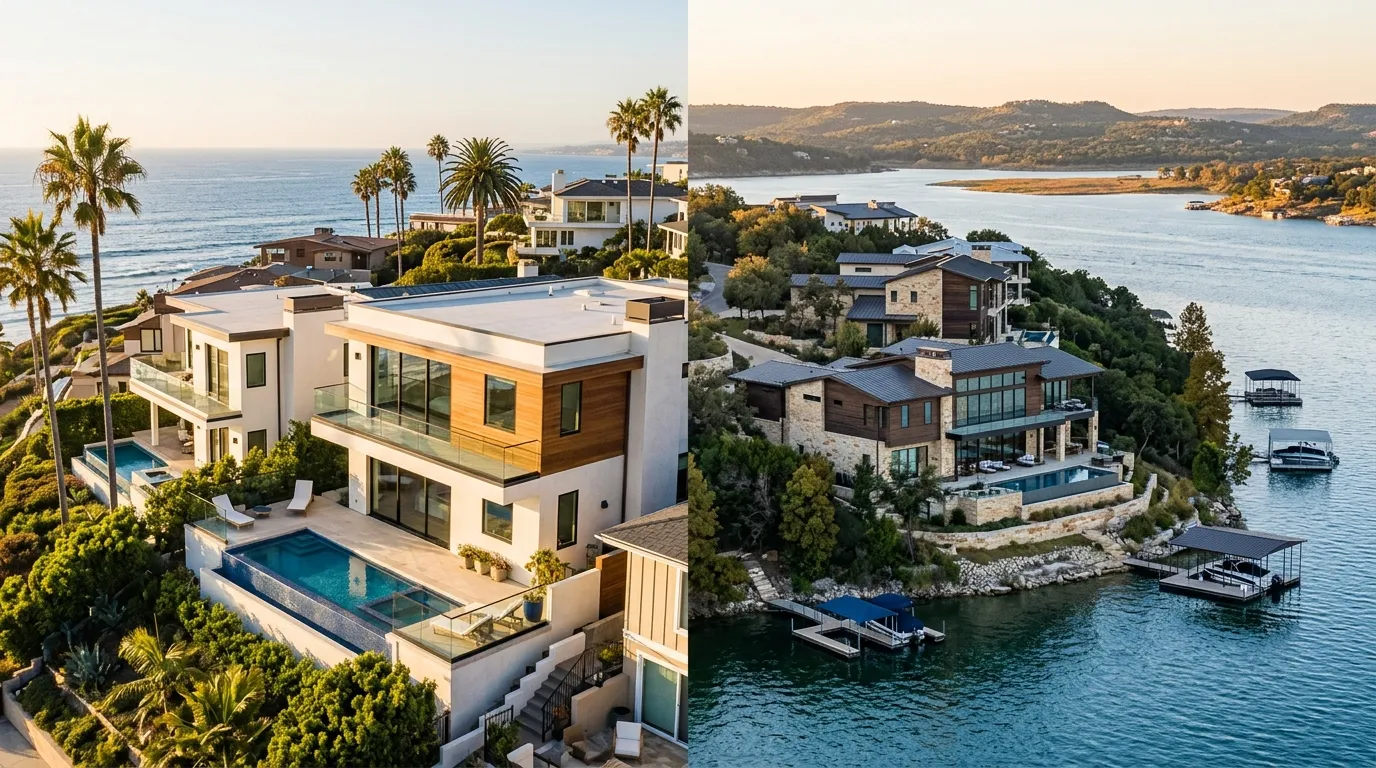
Moving from San Diego to Austin in 2026 saves the typical household $20,000–$35,000 per year in taxes, with housing costs running roughly 40–50% lower and no California state income tax. A San Diego budget of $1.5 million that buys a 3-bedroom home near La Jolla buys a luxury lakefront-community home in Lakeway or a large Westlake property with Eanes ISD schools. San Diego transplants most often land in Lakeway, Bee Cave, and the Lake Travis corridor — drawn by the outdoor and water lifestyle — or in Cedar Park and Leander for family-focused school districts.
William Zhang is an Austin relocation specialist with eXp Realty (TREC #811948) who has helped San Diego and Southern California families evaluate Austin neighborhoods, school districts, and the lifestyle transition. He works with buyers who want a straight comparison — not a sales pitch — of what Austin actually offers versus what they are leaving behind.
The Short Version for San Diego Buyers
- Austin’s median home price (
$520,000) is 40–50% lower than San Diego’s ($950,000–$1.1M) - No Texas state income tax — California’s top rate is 13.3%, a major annual savings for most households
- Lake Travis replaces the ocean — not perfectly, but better than anything else in Central Texas
- Summer heat is a real adjustment. San Diego averages 76°F in July. Austin averages 98°F.
- Top schools exist in Austin — Eanes ISD, Lake Travis ISD, and Leander ISD are all competitive with California’s best
- Car-dependent lifestyle — no transit network comparable to San Diego’s Trolley or Coaster
What $1.5 Million Buys: San Diego vs Austin
| Market | What $1.5M Buys in 2026 |
|---|---|
| San Diego (La Jolla) | 3 bed/2 bath single-family, moderate yard |
| San Diego (Del Mar) | Entry-level home, small lot |
| San Diego (Mission Hills) | Older 3-bed craftsman with updates needed |
| Austin — Lakeway (Lake Travis ISD) | 4–5 bed luxury home, lake access community, marina |
| Austin — Westlake (Eanes ISD) | 4 bed/3.5 bath ~3,500 sq ft, Hill Country views |
| Austin — Bee Cave | Large new construction on half-acre, great schools |
The dollar-for-dollar comparison favors Austin significantly. San Diego transplants typically upgrade in every material dimension except proximity to the ocean.
The Tax Math for San Diego Households
A San Diego household earning $250,000 per year moving to Austin:
In California:
- California state income tax (effective ~9.3%): ~$23,250/year
- Property tax on a $950,000 home (effective ~1.1%): ~$10,450/year
- Total state + property tax: ~$33,700/year
In Austin (buying a $550,000 home):
- Texas state income tax: $0
- Austin-area property tax on $550,000 (effective ~2.2%): ~$12,100/year
- Total state + property tax: ~$12,100/year
Annual savings: ~$21,600. The mortgage savings on a smaller purchase add further to the gap.
These are illustrative. Your actual tax picture depends on deductions, filing status, and business structure. Consult a Texas CPA before making assumptions.
The Lake Lifestyle: Replacing San Diego’s Ocean
San Diego transplants arrive with a water lifestyle expectation, and the honest answer is: Austin’s version is different, but there is a real substitute.
Lake Travis is a 65-mile reservoir on the Highland Lakes chain in the Hill Country. It is large enough for serious boating, has multiple marinas, a sailing club, and several lakefront communities. Water temperature is warm (80°F+) from May through October. In a strong rainfall year, the lake is gorgeous; in drought years, lake levels drop noticeably.
What Lakeway and Rough Hollow offer:
- Direct lake access and private marinas
- Infinity pool and resort-style clubhouse amenities (Rough Hollow)
- Hiking trails along the lake
- Restaurants and bars on the water
- Boat slips available in the community
What it is not: There are no waves, no saltwater, no tidal pools, no surfing, and no marine layer to cool summer afternoons. Lake Travis is a warm freshwater reservoir. The trade-off for most San Diego transplants is accepting that the water lifestyle continues in a different form.
Other water access: Barton Springs Pool in Zilker Park is a spring-fed public pool that stays around 68°F year-round — a beloved Austin institution. Lady Bird Lake in downtown Austin has kayak, paddleboard, and canoe rentals on the Colorado River.
Where San Diego Transplants Live in Austin
Based on buyer patterns, here is where San Diego buyers tend to land:
Lakeway and Rough Hollow: The first choice for lake-lifestyle buyers. Lake Travis ISD schools, community marina, resort amenities, and Hill Country feel. Prices range from $600,000 to $2M+. See the Lakeway neighborhood guide.
Bee Cave: Immediately east of Lakeway, slightly more affordable, with access to Lake Travis ISD and the Hill Country Galleria retail area. Strong family community feel.
Cedar Park (Leander ISD): For San Diego families where schools are the primary variable. Leander ISD has multiple nationally recognized high schools. Newer housing stock at $450,000–$850,000. See the Cedar Park neighborhood guide.
South Austin / Zilker / Bouldin Creek: San Diego transplants who want walkability, a food scene, and a relaxed outdoor culture often connect with South Austin’s feel — proximity to Barton Springs, Barton Creek Greenbelt, and Lady Bird Lake. More expensive per square foot than suburbs but urban in character.
Mueller: A planned community in East Austin with walkability, parks, and modern homes. Popular with transplants who want a neighborhood feel with city proximity. Median around $500,000–$700,000.
Round Rock: Good schools (Round Rock ISD), newer construction, and solid value. See the Round Rock neighborhood guide.
Austin vs San Diego Weather: The Honest Version
San Diego regularly appears on “best weather in America” lists for a reason. The Pacific Ocean moderates temperatures year-round — highs rarely above 85°F in summer, lows rarely below 45°F in winter, with consistent marine layer mornings and low humidity.
Austin’s climate is distinctly different:
- Summer (June–September): Average July high of 98°F, with stretches of 100°F+ lasting weeks. Humidity varies but can be significant. No ocean moderation.
- Spring (March–May): Warm, often beautiful, with dramatic thunderstorms. The Texas wildflower season is genuinely spectacular.
- Fall (October–November): Mild and pleasant. One of Austin’s best selling points.
- Winter (December–February): Mild by most standards — average January high in the upper 50s. Occasional freezing events (2021’s Winter Storm Uri was a once-in-a-generation event but a reminder that Texas infrastructure is not built for extended cold).
Visit Austin in August before committing. The summer heat is not a minor difference from San Diego — it is a major lifestyle shift, and it requires behavioral adjustment: earlier outdoor activities, air conditioning as a constant, and different vacation timing.
Schools in Austin for San Diego Families
Austin’s top school districts are competitive with California’s best:
- Eanes ISD (Westlake): Small district, very high performance, top 5% nationally.
- Lake Travis ISD (Lakeway, Bee Cave, Rough Hollow): Strong academics, beautiful new facilities, growing district.
- Leander ISD (Cedar Park, Leander): Large district, multiple nationally recognized high schools, strong STEM.
- Round Rock ISD: Solid and improving, multiple strong high schools.
Verify the exact school attendance zone for any specific address. Neighborhood boundaries do not always align with district boundaries, and some neighborhoods are split between ISDs.
More detail in the top Austin school districts guide and best neighborhoods for families in Austin.
Texas Property Taxes and the Homestead Exemption
Texas property tax rates in the Austin metro run 1.8–2.8% of assessed value per year. This is higher than California’s Prop 13 effective rates. However:
- Austin homes cost 40–50% less than comparable San Diego homes
- The homestead exemption reduces your taxable value by $100,000 for school district taxes and caps annual appraisal increases at 10%
- No state income tax offsets the property tax difference for most households
File the homestead exemption with your county appraisal district (Travis, Williamson, or Hays County depending on your address) after closing. It is not automatic, and every San Diego buyer who moves to Austin should do this as one of the first post-closing tasks.
Austin’s Job Market for San Diego Transplants
Austin’s major employers span tech, healthcare, government, and education:
- Tech corridor: Apple (Parmer Lane), Google (downtown), Meta, Oracle, Dell, Samsung, AMD, IBM, Tesla (Gigafactory)
- Healthcare: St. David’s HealthCare, Ascension Seton, UT Health Austin
- State government: Large employer in downtown Austin — relevant if your background is in public administration or policy
- University of Texas at Austin: Major research university and employer
For remote workers moving from San Diego, Austin’s time zone (Central) aligns better with both coasts than Pacific time, which is useful for distributed teams.
Texas Driver’s License and Registration Timeline
Texas requires new residents to get a Texas driver’s license within 90 days and register vehicles within 30 days (after a mandatory safety inspection). DPS appointment wait times can be 2–4 weeks — schedule as soon as you have a Texas address. You will need your California license, proof of Texas residency, and Social Security number.
What to Do Before You Move
- Visit Austin in August to honestly assess the heat. One visit in March will not prepare you for summer.
- Spend time on Lake Travis during a Lakeway visit to evaluate whether it scratches the water lifestyle itch.
- Drive potential commutes at rush hour — do not rely on midday Google Maps estimates.
- Talk to a Texas CPA about your specific tax situation before assuming savings.
- File the homestead exemption after closing.
- Budget for property tax year two if buying new construction — assessed value typically jumps from lot value to full home value in the second year.
How William Zhang Helps San Diego Transplants
William Zhang is an Austin relocation specialist with eXp Realty (TREC #811948) who has helped San Diego families evaluate the lake lifestyle neighborhoods, school districts, and outdoor recreation access that San Diego transplants care most about. His process includes virtual neighborhood tours by video, in-person walk-throughs, school district verification at the address level, and remote closing coordination for buyers who need to close without making multiple trips.
For the broader California-to-Austin picture, see the moving from California to Austin guide.
Ready to Talk About Your Move?
If you are seriously considering moving from San Diego to Austin and want a real conversation — not a sales pitch — about what you are trading and what you are gaining, text or call William Zhang at (512) 766-3188 or get in touch.
Frequently Asked Questions
How much cheaper is Austin than San Diego in 2026?
Austin is roughly 30% cheaper overall than San Diego, with housing showing the largest gap. The median home price in San Diego runs around $900,000–$1.1 million, while Austin's median sits around $520,000. Beyond housing, Austin's cost of goods and services is approximately 22% lower. The biggest financial advantage is Texas's lack of state income tax — California's top rate is 13.3%, so a household earning $250,000 saves roughly $23,000–$28,000 per year just on income tax.
What is the equivalent of San Diego beach lifestyle in Austin?
Lake Travis is the closest equivalent for San Diego transplants. It is a large Highland Lakes reservoir with marinas, boat rentals, swimming areas, and lakefront restaurants. The Lakeway and Rough Hollow communities have direct lake access, a marina, and resort-style amenities. It is not the Pacific Ocean — there are no waves, no saltwater, and no coastal marine layer — but for water-focused recreation and outdoor lifestyle, Lake Travis comes closer than anywhere else in the Austin area.
Where do San Diego transplants typically live when they move to Austin?
San Diego transplants most commonly choose Lakeway, Bee Cave, Rough Hollow, and the Lake Travis corridor for the outdoor and water lifestyle. Families prioritizing schools often choose Cedar Park or Leander (Leander ISD). San Diego buyers who want a more urban feel and walkability tend toward South Austin, East Austin, or Mueller. Those seeking maximum space and value choose Dripping Springs or Georgetown.
How does Austin weather compare to San Diego?
San Diego has some of the most temperate climate in the United States — average July high around 76°F with ocean moderation. Austin's average July high is 98°F with no ocean breeze. The heat is dry to humid and can be relentless from June through September. Spring and fall in Austin are genuinely pleasant. Winter is mild. If you are moving from San Diego, the summer heat is a real and significant lifestyle change — visit in August before deciding.
What does $1.5 million buy in San Diego vs Austin?
In San Diego, $1.5 million buys a 3-bed/2-bath home in a desirable neighborhood like La Jolla or Del Mar, or a modest single-family in a middle-tier area. In Austin, $1.5 million buys a luxury 4–5 bed home in Westlake (Eanes ISD) or Lakeway with lake access, or a large new construction home on significant acreage in Bee Cave or Dripping Springs.
Is Austin a good fit for outdoor-oriented San Diego transplants?
Yes, with different activities. Austin has Barton Springs Pool (fed by natural springs, cool water year-round), the Barton Creek Greenbelt with miles of hiking and swimming holes, Lake Travis for boating and paddle sports, the Colorado River (Lady Bird Lake) for kayaking and paddleboarding, and Pedernales Falls State Park and Hamilton Pool Preserve nearby. The activities are different from San Diego's beach and surf culture, but there is no shortage of outdoor recreation.
How do Texas property taxes compare to California for San Diego buyers?
Texas property tax rates (1.8–2.8% of assessed value) are higher than California's Prop 13-constrained effective rates. However, San Diego home prices are significantly higher than Austin's, so the dollar amount of property taxes is often similar or lower in Austin even at a higher rate. The elimination of California state income tax typically more than offsets any property tax difference for most San Diego households.
Do I need a Texas driver's license after moving from California?
Yes. Texas requires new residents to get a Texas driver's license within 90 days of establishing residency and register vehicles within 30 days. Vehicles require a safety inspection before registration. DPS appointment wait times in Austin can run 2–4 weeks, so schedule as soon as you have a Texas address.
Should I rent first or buy directly when moving from San Diego to Austin?
If you know your target neighborhood and have stable employment, buying directly is usually the better financial decision. Austin's rental market is competitive and averages $1,600–$2,200 per month for a one-bedroom. Double moves and double closing costs add up quickly. Renting first makes sense if you are uncertain about your preferred area — San Diego transplants sometimes change their minds between wanting the lake lifestyle (Lakeway) and a more urban feel (East Austin, South Austin) after spending time in both areas.
Have questions about Austin real estate?
Reach out — I'm happy to help with your home search or sale.