Austin Housing Market Spring 2026: Q2 Prices & Inventory
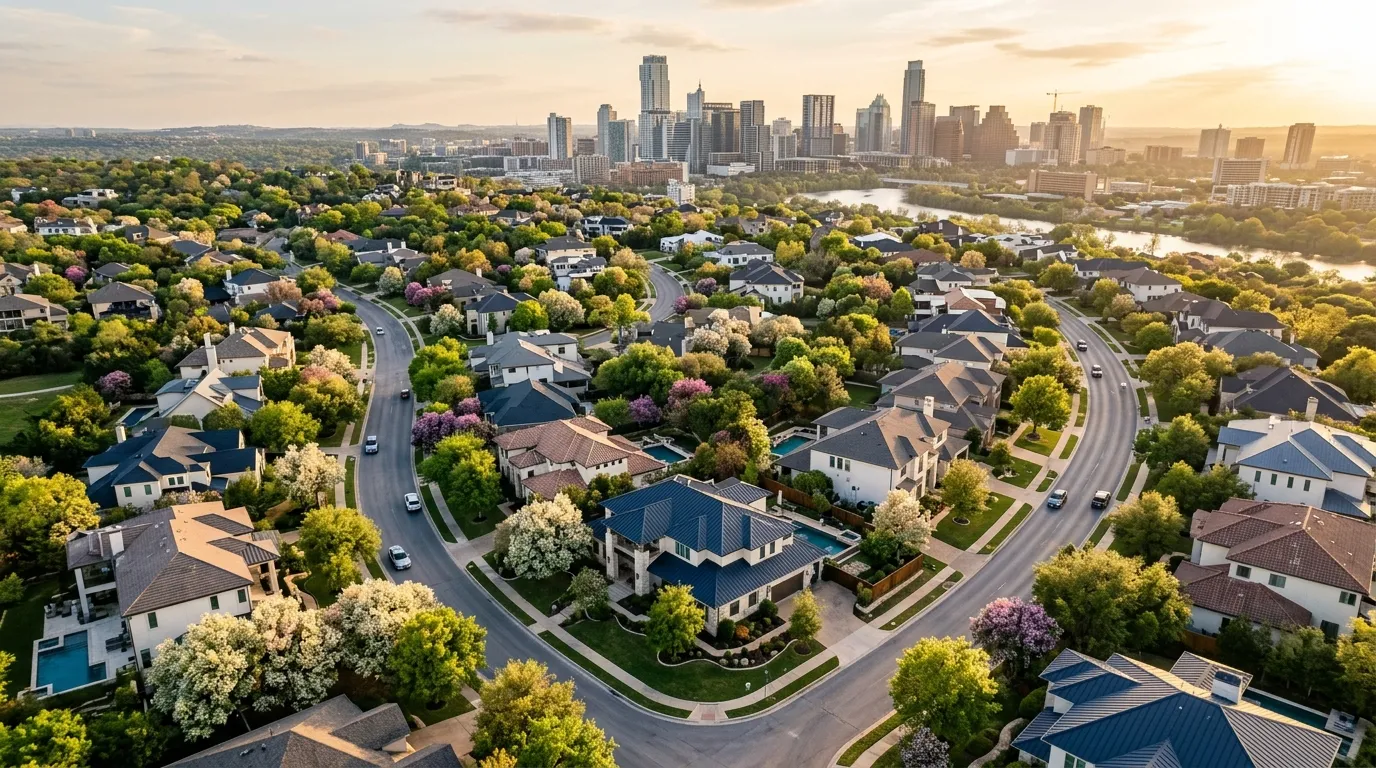
The Austin housing market spring 2026 data tells a specific story: the Austin–Round Rock–San Marcos MSA had a median sales price of $426,220 in March 2026 (down 3.4% year-over-year), 5.5 months of active inventory across 33,751 listings, homes averaging 82–85 days on market, a close-to-list price ratio of 92.6%, and rents declining 5–7% year-over-year as vacancy rates hit nearly 13.8%. Pending sales, however, rose 15.4% in March alone — a signal that buyer activity is picking up heading into Q2.
William Zhang is an Austin real estate agent with eXp Realty (TREC #811948) who tracks the Austin MSA numbers monthly. The Q1 2026 data — sourced from the Unlock MLS March and Q1 2026 Central Texas Housing Report and Texas Realtors Q1 2026 summary — shows a market that has meaningfully shifted since the January 2026 snapshot. Inventory expanded, spring demand is building, and the gap between list price and sale price has widened. Here is what those numbers mean in practice for buyers and sellers this spring.
Median Price: $426,220 in March — Seasonal Lift, Not a Reversal
The March 2026 median of $426,220 represents the typical seasonal spring increase from January’s $400,495 — not a reversal of the broader correction. Year-over-year, March 2026 was 3.4% below March 2025. That decline is steeper than January’s 2.3% year-over-year dip, which reflects how strong the first half of 2025 was comparatively, not a re-acceleration of price drops.
April 2026 month-to-date data is tracking around $440,000–$450,000 as spring listings absorb a stronger buyer pool. The SmartAsset study cited by CultureMap Austin placed the Austin metro as the fourth-largest market for home value declines since 2025 nationally — context that matters when sellers are setting expectations.
For buyers in Round Rock, Cedar Park, and Pflugerville: the spring price lift is real, but you are still buying into a market where close-to-list ratios average 92.6%. That means a $500,000 list price has been closing around $463,000 on average across the metro. The median is not your comp — the specific closed transactions in the ZIP code and price band you are targeting are. Pull the last 90 days of sales, not the headline number.
For sellers: a spring listing is the right move if you are priced within 2–3% of actual comps. The seasonal tailwind is working in your favor in May. But buyers are informed — the Zillow, Realtor.com, and KXAN market trackers all publish these numbers publicly. Overpricing by 8–10% to leave room to negotiate is a strategy that costs you weeks of market time and flags your listing as stale.
Closed Sales and Pending: The Volume Divergence
Q1 2026 closed sales across the Austin MSA totaled 6,186 homes — a 1.8% decrease from Q1 2025. March specifically closed 2,593 transactions, essentially flat (up 0.5%) versus March 2025.
The more important number is pending sales: 8,110 pending transactions in Q1 2026, up 10.9% from Q1 2025. March alone logged 3,357 pending sales, up 15.4% year-over-year. Pending sales lead closed sales by 30–60 days, which means April and May 2026 closed counts should be materially stronger than Q1.
Texas Realtors Q1 2026 statewide report noted that Texas metros were roughly split between markets with increases and decreases in closed sales — Austin’s slight decline is consistent with a metro that experienced the largest price correction in the state and is working through that recalibration.
The volume story is straightforward: buyers who have been sitting on the sidelines waiting for rates or prices to move are beginning to act. Mortgage rates hitting 6.23% in late April 2026 — the lowest spring level in three years per data from Austin TX Homes Sales — provided the trigger for some of that activity.
Inventory by County: 5.5 Months Across the Metro, But Not Uniform
The metro-wide 5.5 months of inventory as of March 2026 masks meaningful variation by county.
Travis County (City of Austin): The most expensive and most resilient segment. Travis County had the highest new listing volume in March 2026 at 2,549 new listings. Supply of luxury properties ($1M+) is elevated — 1,159 of the 1,549 luxury listings across the metro as of early April were in Travis County. The City of Austin proper continues to command a price premium, but even here, the close-to-list ratio data and extended DOM indicate buyers have real negotiating room.
Williamson County (Round Rock, Cedar Park, Georgetown): The tightest sub-market at 4.6 months of inventory — still technically a buyer’s market, but meaningfully more competitive than Hays County. Round Rock and Cedar Park benefit from Round Rock ISD and Leander ISD school zones, which maintain demand. New construction from builders in Georgetown, Leander, and Hutto is competing with resale here — and builders are still offering rate buydowns and closing cost contributions to move spec inventory. That builder competition gives resale buyers in Williamson County real leverage.
Hays County (Buda, Kyle, San Marcos): The most buyer-friendly pocket of the metro. Hays County median prices remain the lowest of the three primary counties, inventory is elevated, and new construction volume is high. The combination of builder competition, lower price points, and extended DOM makes Hays County the strongest negotiating environment in the metro for buyers right now.
Days on Market: 82–85 Days — What That Time Buys You
The spring 2026 DOM figure of 82–85 days is a modest improvement from January’s 89-day average, but still far above the sub-10-day sprint of 2021. The Q1 2026 Unlock MLS report confirms the close-to-list ratio of 92.6% — homes are moving, but not fast and not at full ask.
For buyers, 82 days means you have time to do things right. Schedule a full home inspection. Bring in a structural engineer for any foundation concerns — Austin’s expansive clay soil across Travis and Williamson County makes this non-optional on older homes. Get a survey. Run the actual comps before submitting an offer. The buyer who rushed through due diligence in 2021 to compete is still paying for some of those decisions. There is no pressure in this market to skip any of those steps.
For sellers, 82 days is the average — which means overpriced and underprepared homes are pulling that number up significantly. Well-priced homes in Pflugerville (78660, 78653) within Round Rock ISD boundaries, or in Cedar Park within Leander ISD, are moving faster than the metro average. Condition matters. Buyers are doing thorough inspections and using every finding to negotiate. If your home has deferred maintenance, price for it upfront — buyers will find it and deduct for it, typically more aggressively than the actual repair cost.
Mortgage Rates: 6.23%–6.51% — The Spring Window
The 30-year fixed mortgage rate dropped to a 6.23% average by late April 2026, the lowest spring level in three years. As of May 6, 2026, rates are at 6.48%–6.51% nationally, with some Austin lenders quoting as low as 5.875% for well-qualified borrowers.
On a $426,000 purchase with 10% down at 6.5%, the principal and interest payment is approximately $2,430/month. That is before taxes, insurance, and HOA. On the same loan at the 2023 peak rate of 8%, that payment was $2,813/month — a $383/month difference. Rates are still elevated by historical standards, but the spring 2026 window is meaningfully better than 2023 and early 2024.
Builder incentives on new construction continue to improve that math. A 2/1 rate buydown on a $450,000 new build in Georgetown or Leander drops the effective first-year rate to 4.23%–4.51%, saving $500–$700/month in year one. For buyers comparing resale in Round Rock or Cedar Park to new construction in the northern suburbs, that buydown calculation is part of the real comparison.
Rental Market: Rents Down, Vacancy Up — No Rush to Buy
Median rent across Austin is running $1,823–$1,900 per month as of April 2026, down 5–7% year-over-year across most unit types. The Pew Charitable Trusts published a March 2026 analysis specifically on Austin’s supply-driven rent decline, attributing the softening to the delivery of over 30,000 new apartment units in the past year. Vacancy rates have reached approximately 13.8% — a multi-year high — giving renters real leverage on lease terms.
This is the rental environment that is partly keeping some would-be buyers in lease mode longer. With more options, lower rents, and flexible lease terms, the urgency to buy has diminished for some households. That is a rational response. If you need six more months to find the right house in the right school district at the right price, the rental market is not punishing you for waiting the way it was in 2022, when median rents peaked above $2,400 and vacancies were near zero.
For investors evaluating the Austin buy-to-rent market: the 13.8% vacancy rate and 5–7% rent declines have compressed cap rates significantly. Any rental income projection built on 2022 or 2023 rent assumptions should be rebuilt with current numbers before underwriting a purchase.
Spring 2026 vs. January 2026: What Changed in Four Months
The January 2026 report showed a market at 4.0 months of inventory, a $400,495 median, and 89 days on market. Four months later:
- Inventory expanded from 4.0 to 5.5 months — the market shifted further into buyer’s market territory
- Median price moved from $400,495 (January) to $426,220 (March) — seasonal spring lift, but year-over-year still down 3.4%
- DOM improved slightly from 89 to 82–85 days — spring demand absorbing some of the backlog
- Pending sales surged 15.4% in March — the clearest positive signal in the Q1 data
- Active listings rose 4.5% year-over-year to 33,751 — buyers have more to choose from
The trajectory is not a recovery in the traditional sense — prices are not rising in real terms. It is a market that is finding its Q2 rhythm: more listings, more buyers, longer timelines, and tighter negotiation. The headline that Austin has posted four consecutive years of annual price declines (per the SmartAsset study) is accurate, but the pace of those declines has slowed from 15.5% in 2023 to 3.4% in Q1 2026.
What This Means for Buyers This Spring
The spring 2026 Austin housing market data supports a specific buyer posture.
Negotiate from comps, not emotion. The average close-to-list ratio of 92.6% across the metro means list prices are starting points, not endpoints. Identify the last 90 days of closed sales in the specific ZIP code and price range. Your offer should be anchored to those numbers, adjusted for condition and any deferred maintenance uncovered in inspection.
Keep all contingencies intact. Inspection, financing, appraisal — these exist for your protection. You do not need to waive them in this market. Any agent advising you to waive contingencies to be competitive in May 2026 is not giving you accurate market advice.
Compare new construction seriously. Builders in Georgetown, Leander, Hutto, and the Pflugerville submarkets are actively offering rate buydowns and closing cost contributions. A 2/1 rate buydown on a $450,000 build saves real money in years one and two. Run the actual payment comparison — the sticker price on new construction often looks higher until you factor in the rate incentive.
Target Pflugerville and Williamson County for value. Pflugerville (78660, 78653) offers Round Rock ISD schools at lower price points than Cedar Park or Round Rock proper. Cedar Park and Round Rock offer Leander ISD and Round Rock ISD respectively at moderate inventory levels. All three represent better value than comparable Austin city proper square footage at current price levels.
You can search current active Austin MLS listings at lifeinaustintx.com. For a direct conversation about where your budget fits in this market, reach out here.
If you are a first-time buyer, the how to buy a home in Austin 2026 guide walks through the full process from pre-approval to close, specific to this market.
What This Means for Sellers This Spring
Sellers in May 2026 have the seasonal tailwind working for them — but not the pricing power that characterized 2021–2022. The spring surge in pending sales is real, but the buyers generating that activity are disciplined and data-literate.
The sellers doing well right now are pricing within 2–3% of the most recent comps, coming to market with the home fully prepared, and considering upfront closing cost contributions rather than waiting for lowball counters to force concessions. A $7,500–$10,000 closing cost credit on a $450,000 home is often more effective at attracting competitive offers than reducing the list price by the same amount — the net to seller is similar, but the buyer can use the credit to reduce their cash-to-close.
The counter-argument for waiting: the pending-sales surge in March suggests May and June could bring more buyer competition. If you can time your list for the first two weeks of May, you are likely to see the highest foot traffic of the spring cycle. After Memorial Day, buyer activity typically softens through the summer.
For sellers evaluating whether to list or lease: the rental vacancy rate at 13.8% and median rent at $1,823–$1,900 makes the lease path harder than it appears. You would be entering the most competitive rental market Austin has seen in years, competing against 33,000+ active listings for tenants, likely accepting rates that may not cover your carrying costs depending on your loan balance and rate.
The Austin neighborhood guides are a useful starting point for understanding where your property sits in the current market. For a direct conversation about pricing strategy and timing, reach out directly.
The Bottom Line on Austin Spring 2026
William Zhang, an Austin real estate agent with eXp Realty (TREC #811948), tracks these numbers because the difference between a well-timed, well-priced decision and an expensive mistake in this market often comes down to understanding which direction the data is actually moving — not what it was doing 12 months ago.
The spring 2026 Austin housing market is a buyer’s market on inventory metrics, but the 15.4% surge in pending sales means that window is not wide open indefinitely. Buyers have real negotiating leverage today. Sellers who price correctly are still moving properties. And the renters who have been waiting — the Austin rental vacancy rate giving them time and options — are beginning to convert into buyers as mortgage rates hit a three-year spring low.
The data supports acting this spring if you are a buyer who is ready. It supports pricing discipline if you are a seller. And it supports a realistic view of rental income potential if you are an investor. That is what the Q2 numbers actually say.
Frequently Asked Questions
What is the median home price in Austin in spring 2026?
The Austin–Round Rock–San Marcos MSA median sales price was $426,220 in March 2026, according to the Unlock MLS Q1 2026 Central Texas Housing Report. That is down 3.4% year-over-year from March 2025. April 2026 month-to-date data is tracking around $440,000–$450,000 as spring listings absorb stronger buyer activity.
How much inventory is in the Austin housing market in spring 2026?
The Austin metro had 5.5 months of active inventory in March 2026, with 33,751 active listings — a 4.5% increase year-over-year. Williamson County ran slightly tighter at 4.6 months. Five-plus months of inventory puts the market firmly in buyer's market territory, especially compared to the 0.7–1.5 months of the 2021 frenzy.
How long are homes sitting on the market in Austin in 2026?
Homes across the Austin MSA averaged 82–85 days on market through March and April 2026. The average close-to-list price ratio was 92.6% in Q1 2026, meaning most homes are selling about 7% below asking. Well-priced, move-in-ready homes in desirable school zones are still selling faster than the average.
Are pending sales rising in Austin in 2026?
Yes. Pending sales in the Austin MSA rose 10.9% in Q1 2026 compared to Q1 2025, and March alone saw pending sales jump 15.4% to 3,357 transactions. That forward-looking demand signal suggests April and May closed-sale counts should be stronger than Q1 numbers imply.
What is happening with Austin rents in spring 2026?
Median rent in Austin is approximately $1,823–$1,900 per month as of April 2026, down 5–7% year-over-year across most unit types. Over 30,000 new apartment units delivered in the past year pushed vacancy rates to nearly 13.8%, giving renters significant leverage on lease terms and concessions.
Is Austin a buyer's or seller's market in spring 2026?
With 5.5 months of active inventory, an average close-to-list price of 92.6%, and homes averaging 82–85 days on market, the Austin metro is currently a buyer's market. Buyers can negotiate on price, keep contingencies intact, and take time for proper due diligence — none of which was possible in 2021–2022.
How does the Austin spring 2026 market compare to January 2026?
Inventory expanded from 4.0 months in January 2026 to 5.5 months in March 2026. The median price moved from $400,495 (January) to $426,220 (March), reflecting seasonal spring appreciation. Days on market improved slightly from 89 days to 82–85 days. The biggest change is in pending sales, which surged 15.4% in March, indicating buyer activity is accelerating into Q2.
What are Austin home prices forecast to do in 2026?
Based on Q1 2026 data, Austin home prices are likely to remain range-bound — modest year-over-year declines of 1–3% through mid-2026 as elevated inventory and ongoing new construction keep pricing competitive. The accelerating pending-sales trend suggests the pace of declines is slowing. A return to meaningful price growth requires either a significant drop in new listings or a substantial increase in buyer volume.
Have questions about Austin real estate?
Reach out — I'm happy to help with your home search or sale.