Is Upsizing Your Austin Home a $100,000 Mistake in 2026?
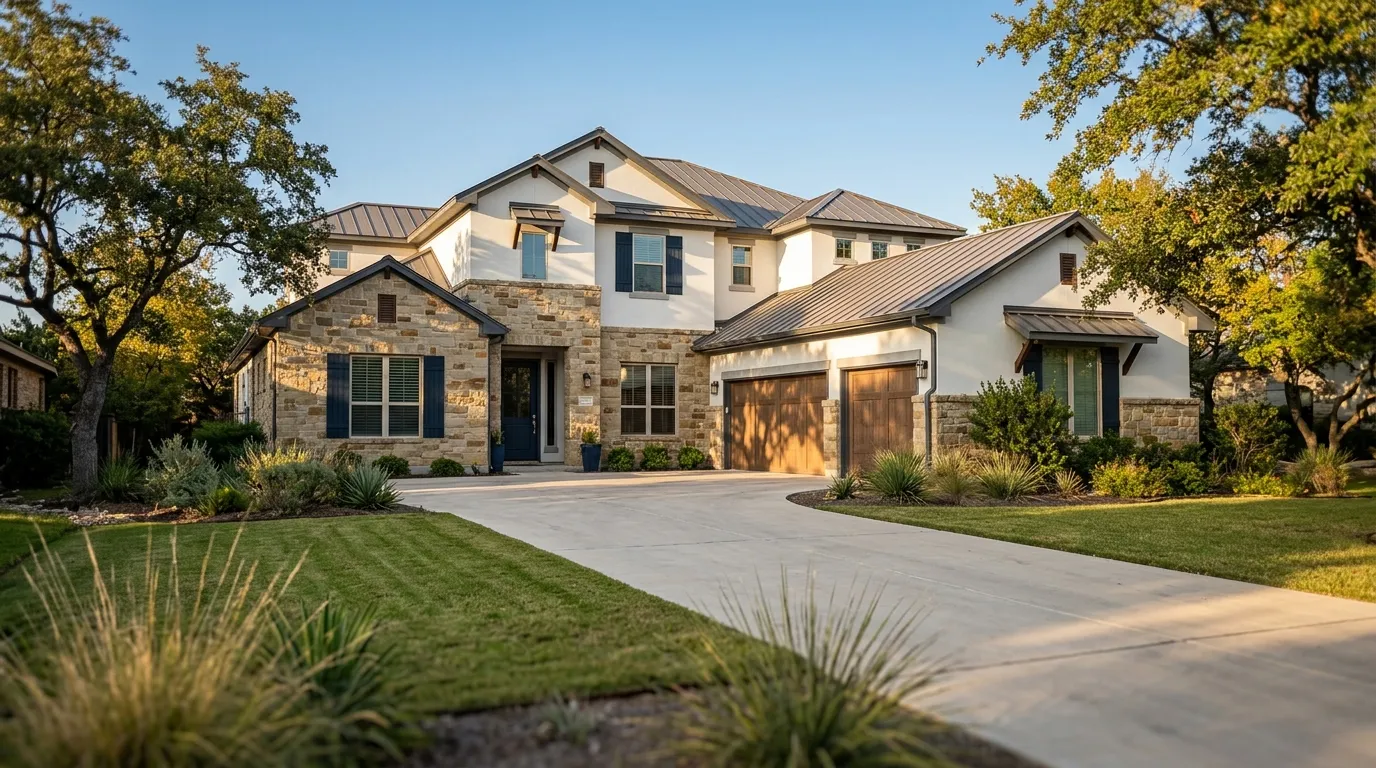
Before you upsize your Austin home in 2026, run the actual numbers. Not the mortgage payment estimate from Zillow — the full cost of the move, including what you are giving up.
I’m William Zhang, an Austin real estate agent with eXp Realty (TREC #811948). The question of upsizing Austin home in 2026 comes up in almost every conversation I have with families who bought starter homes in 2019–2021. They are in 1,600 square feet, they have two kids now, and they are looking at 2,400-square-foot homes in Cedar Park or Round Rock. The instinct is right. The timing math is complicated.
Here is the core problem: a significant portion of Austin homeowners who bought before 2022 have mortgage rates in the 2.5–3.5% range. Moving to a larger home today means taking on a new mortgage at 6.5–7%. That rate differential, combined with closing costs on both ends and a property tax reset, can easily push the true cost of upsizing past $100,000.
That does not mean upsizing is always wrong. It means you need to know what you are actually paying before you decide.
The Rate Differential: The Single Biggest Cost
This is where most families underestimate the expense. They focus on the difference in payment and call it a day. The payment difference on a 30-year loan is real, but the compounding cost is larger than it looks.
A rough example: You have a $400,000 home with a $320,000 mortgage balance at 3%. Your monthly payment on that portion is approximately $1,349. You want to buy a $600,000 home in Round Rock or Leander. You put your Austin home proceeds toward the new purchase. After the sale, transaction costs, and down payment, you are borrowing roughly $480,000 at 6.75%.
That monthly payment: approximately $3,115. The difference is $1,766 per month. Over five years: $105,960.
That is the rate differential cost alone, and it does not include transaction costs or the property tax increase. For many families in that scenario, the question becomes: is 800 more square feet and an extra bedroom worth $1,766 per month?
Sometimes it is. If you are genuinely out of space — a home office is gone, the kids are sharing a room and it is no longer manageable — then yes, the quality-of-life value can justify that cost. But “I’d like a bigger kitchen” is a different justification than “we are actually running out of functional space.”
Transaction Costs: The Number Nobody Talks About Upfront
The cost to sell your current Austin home and purchase a new one is real money that leaves your account permanently.
Selling costs:
- Agent commission (typically 3% on the listing side, plus buyer’s agent contribution): $12,000–$15,000 on a $400,000 home
- Title company, prorated property taxes, HOA transfer fees: $3,000–$5,000
- Staging and prep (paint, repairs, landscaping): $3,000–$8,000
- Total: roughly $18,000–$28,000 to sell a $400,000 home
Buying costs:
- Lender fees, appraisal, credit report: $3,000–$5,000
- Title insurance, survey, inspection: $4,000–$6,000
- Prepaid interest and escrow setup: $5,000–$8,000
- Total: roughly $12,000–$19,000 to close on a $600,000 home
Combined transaction costs: $30,000–$47,000. Add that to the rate differential and you can see how the $100,000 figure builds quickly.
Property Tax Reset in Texas
Texas does not have a state income tax, but it does have some of the highest property tax rates in the country. Effective rates in Travis County run 1.8–2.2% of assessed value. In Williamson County (Round Rock, Cedar Park, Georgetown), they are 2.0–2.5%. Some Municipal Utility District (MUD) areas in the newer suburbs — Leander, Hutto, Pflugerville outskirts — add an extra 0.3–0.8% on top of the base county and city rates.
When you bought your starter home three or four years ago, your assessed value was lower. Under Texas homestead exemption rules, the county can only raise your assessed value by 10% per year — so longtime homeowners often pay taxes on an assessed value well below market. Once you sell and buy, the new home is assessed at full purchase price.
If you are moving from a $400,000 home assessed at $360,000 to a $600,000 home assessed at $600,000, your annual property tax bill could increase by $4,800–$6,000. That is another $400–$500 per month on top of the payment increase.
First thing to do after any Texas home purchase: file your homestead exemption. It does not reduce what you pay in year one, but it caps future increases at 10% per year and locks in a meaningful reduction going forward.
When Builder Incentives Change the Equation
There is one scenario where upsizing in 2026 makes significantly more sense: new construction in the northern and eastern suburbs where builders are actively buying down rates.
In Leander (Northline, Bryson, Crystal Falls communities), Cedar Park, Georgetown (Wolf Ranch, Sun City area), and Hutto (Star Ranch), some builders have been offering 2/1 rate buydowns — meaning year one at 4.75%, year two at 5.75%, then market rate from year three. On a $550,000 home, that buydown can save $500–$700 per month in years one and two.
Some builders are also offering closing cost contributions of $15,000–$25,000 and including upgrades that would cost $30,000–$50,000 as options on a resale.
If you are targeting new construction in those communities, the cost comparison looks different. You are still taking on a higher rate after year two, but the first two years of savings reduce the break-even timeline substantially — particularly if you are planning to stay in the home for 7–10 years.
The key is not to let the builder’s sales team do your math for you. Have your own lender run the numbers and compare the buydown offer against taking the market rate and applying those savings elsewhere.
Decision Framework: Should You Upsize Right Now?
Here is how I walk through this with clients:
Reason to upsize now:
- You have a genuine space problem that affects daily life (not just a preference for more room)
- You plan to stay in the new home 7+ years (transaction costs amortize over time)
- You are targeting new construction with a verified builder incentive that includes a legitimate rate buydown
- Your income has grown enough that the payment increase is under 28–30% of gross monthly income
- Your current home is in a ZIP code where sellers have leverage — meaning you will walk away with more equity than you expect
Reason to wait or consider alternatives:
- Your current home is functional and you are mostly upsizing for lifestyle reasons
- You plan to be in the home 3–5 years (transaction costs kill your return at that horizon)
- Your equity position is limited after the 2022 correction — you may not have a large down payment to soften the rate impact
- You are in a job market or income situation with any uncertainty (higher payment leaves less buffer)
The middle path: Some families in this situation are renovating instead of moving. An addition or renovation in Austin typically runs $150–$250 per square foot for quality work, and you keep your low-rate mortgage. For a family that needs one more bedroom and a larger living area, a $60,000–$80,000 renovation can be dramatically cheaper than upsizing — especially if that renovation does not reset your property taxes the way a new purchase does.
Specific Neighborhood Math for Austin Upsizers
If you are still committed to upsizing, here is where the numbers tend to pencil out best:
Round Rock (78664, 78681): Strong Round Rock ISD schools, resale inventory at $430,000–$520,000 for 2,200–2,800 sq ft. The advantage here is that resale sellers are willing to negotiate, and some will contribute to closing costs — partially offsetting the transaction cost problem.
Cedar Park (78613): Leander ISD access, slightly tighter inventory than Round Rock, median around $450,000–$550,000 for larger homes. Good walkability to retail and restaurants relative to most Austin suburbs.
Leander (78641, 78645): New construction is dominant here. Builders in communities like Larkspur and Bryson are competing aggressively. If you want new and are flexible on commute time, this is where builder incentives are most active.
Georgetown (78628): Wolf Ranch and Morningstar have strong school ratings and access to Georgetown ISD. Slightly farther from central Austin employment, which is why prices have stayed more reasonable. A $550,000 home in Georgetown gets you significantly more square footage than in Cedar Park at the same price.
You can search active listings across all these areas at lifeinaustintx.com. For a conversation about whether upsizing pencils out for your specific situation — including a look at what your current home would sell for — reach out directly or browse the neighborhood guides to see where your target area stands.
Frequently Asked Questions
Is upsizing your Austin home worth it in 2026?
It depends entirely on your numbers. Going from a 3% mortgage to a 6%+ rate on a larger loan can cost $50,000 or more in additional interest over the first five years alone. Add transaction costs (agent commissions, title, lender fees — roughly 8–10% of both the sale and purchase prices), and a property tax reset on the new home, and the total cost of upsizing can easily reach $100,000. That said, builder incentives including 2/1 rate buydowns in Leander, Cedar Park, and Georgetown are changing the math for some families.
What is the rate differential cost when upsizing an Austin home?
If you have a 3% mortgage on a $400,000 home and upsize to a $600,000 home at 6.5%, your monthly payment jumps from roughly $1,686 to $3,792 — a difference of over $2,100 per month. Over five years that is more than $125,000 in additional payments, even before you account for the higher principal balance.
How much does it cost to sell and buy a home in Austin?
Transaction costs to sell an Austin home typically run 6–8% of the sale price (agent fees, title, prorated taxes, staging). Buying costs another 2–4% (lender fees, title insurance, survey, appraisal). On a $400,000 sale and $600,000 purchase, you could easily spend $60,000–$80,000 in transaction costs alone.
Does upsizing reset your property taxes in Texas?
Yes. When you sell your current home and buy a new one, your homestead exemption on the old home does not transfer automatically — you have to apply for a new one on the new property. More importantly, the new home is assessed at its full market value, which can be significantly higher than what you were paying on a home you bought years ago. In Travis County and Williamson County, that can mean an extra $5,000–$10,000 per year in property taxes.
Who should actually consider upsizing in Austin in 2026?
Upsizing makes the most sense when: your family genuinely needs the space (expecting a child, parents moving in, working from home permanently), you plan to hold the new home 7+ years so the transaction costs amortize, and you can qualify for a builder buydown or find a seller willing to contribute to a rate buydown. Growing families targeting Leander ISD or Round Rock ISD — both highly rated districts with new construction available under $550,000 — have a real case for upsizing right now.
Have questions about Austin real estate?
Reach out — I'm happy to help with your home search or sale.