Sell or Lease Your Austin Home in 2026? What the Numbers Say
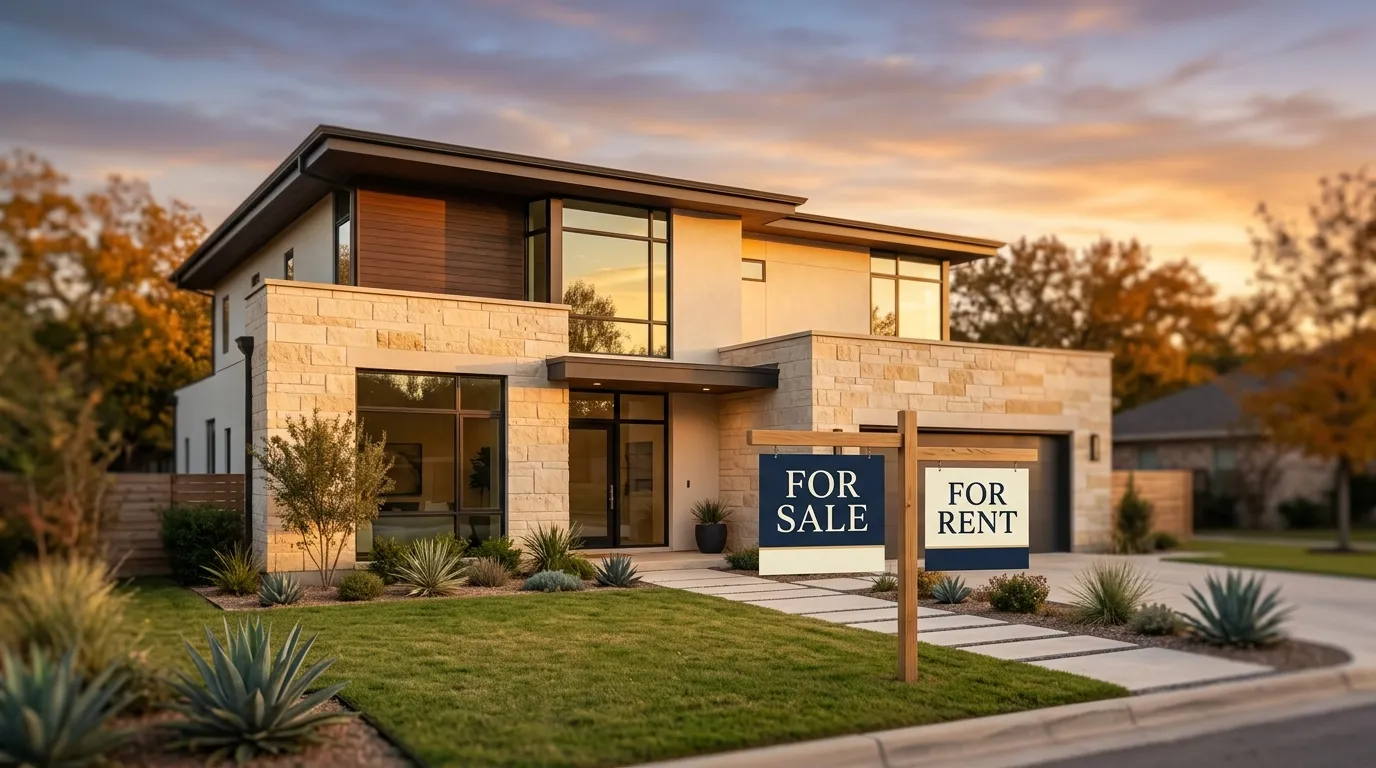
The question coming up in almost every seller conversation I have right now is a version of this: “Should I sell, or should I just lease it out for a while and see what happens?” It’s a reasonable instinct — Austin home prices ran up sharply during the pandemic years, and many owners are sitting on significant equity while wondering if they might be selling at the wrong moment.
I’m William Zhang, a real estate agent with eXp Realty (TREC #811948) covering Austin and the surrounding suburbs. I track market data county by county every month. The January 2026 numbers have a specific story to tell — and what’s happening in the rental market is something every homeowner considering this decision needs to understand before making the call.
What the January 2026 Sale Market Actually Looks Like
Austin (city): Median sales price $522,500, down 5% year-over-year. 509 homes closed, down 8.8%. Active listings at 3,262 — essentially flat. Inventory at 3.9 months, actually down 2 months from last year. Average days on market: 82 days, five days faster than last year. Homes closing at 90.8% of list price.
Travis County: Median $445,000, down 6.3%. 684 closed sales, down 12.4%. Inventory at 3.9 months, down 2 months. Pending sales up 11.1%. Days on market: 87 days, up one day. Close-to-list ratio: 91.1%.
Williamson County (Round Rock, Cedar Park, Georgetown): Median $43,500, down less than 1%. Pending sales up 13.1%. Days on market: 92, up 9 days. Active listings up 5.6%.
Hays County (Kyle, Buda): Median $344,500, down 4% year-over-year. 234 closed sales, down 18.5%. Inventory at 4.4 months. Pending sales up 9.1%.
The pattern across all these counties is consistent: prices are off their peak but not crashing. Pending sales are rising, which means buyers are still writing offers. Inventory has actually tightened in Austin and Travis County compared to last year, which reduces seller competition. The market is balanced, not distressed.
If you need to sell — relocation, life event, financial need — this is a workable market. Homes priced correctly with professional marketing are selling. The ones sitting for 100+ days are typically overpriced for their condition or location.
The Rental Market Numbers Most Homeowners Miss
Here’s where the decision gets more complex. Many homeowners think “I’ll just lease it out” as the easy alternative to selling in a softer market. The January 2026 rental data tells a different story.
Travis County lease market: Active rental listings at 4,216 homes — up 59% year-over-year. New lease listings up 22.5%. Median rent $2,100, down 4.2%. Rental properties sitting on market for 63 days on average.
Austin city lease market: Active rental listings at 4,160 — up 88.5% year-over-year. That number is not a typo. Rental supply has nearly doubled in one year. New leases signed: up 24.4%. Median rent $2,100, down 4.5%.
Hays County lease market: Active rental listings up 10.3%. Rental inventory at 3.3 months, up from essentially zero additional supply the prior year.
What this means practically: if you put your Austin home on the rental market in early 2026, you are competing against nearly twice as many rental listings as existed a year ago. Your home will likely sit vacant for 2+ months during lease-up. You’ll likely have to come in at or below median rent to attract a tenant quickly.
The landlords who leased in 2021 or 2022 at the peak rental rates are in a different position. Those entering the rental market now face a meaningfully more competitive environment.
The Tax Factors That Determine Which Option Wins
This is the part where most homeowners need to sit down with a CPA, not just an agent. But here are the key mechanics:
Section 121 Capital Gains Exclusion
If you sell your primary residence and have lived in it for 2 of the last 5 years, you can exclude up to $250,000 in capital gains from taxable income (single filer) or $500,000 (married filing jointly). This is one of the most valuable tax benefits available to homeowners.
The clock matters. If you move out and convert to a rental, you have a window before that exclusion is no longer available. After more than three years as a rental, your eligibility for the full exclusion begins to erode. Converting to a rental to “wait for the market to recover” can cost you a significant portion of the tax exclusion if you wait too long.
Depreciation Recapture
When you operate a rental property, you can depreciate the structure — typically spreading 1/27.5 of the structure value per year as a tax deduction. This reduces your taxable income during the rental period. But when you sell, the IRS recaptures that depreciation at a tax rate of up to 25%, regardless of your income tax bracket.
Homeowners who have leased for several years and then sell are often surprised by the depreciation recapture bill. It’s entirely real, and it’s separate from capital gains tax. Running a projection of total tax liability under both scenarios with a CPA before deciding is not optional — it’s essential.
Passive Loss Rules
Rental income is considered passive income. Net losses from rental activity (which are common when you factor in management fees, maintenance, property taxes, and depreciation) are generally only deductible against other passive income. If your adjusted gross income exceeds $150,000, passive losses are suspended until you sell the property or have passive income to offset them.
When Selling Makes More Sense
- You have a specific capital gains exclusion window you don’t want to sacrifice
- You don’t want to be a landlord (it’s a real job, even with property management)
- Your carrying costs (mortgage, taxes, insurance) are high relative to achievable rent
- You need the equity for a purchase in another market or for retirement
- You’re moving more than 50 miles away and can’t monitor the property easily
When Leasing Makes More Sense
- Your mortgage rate is below 4% and refinancing later at a higher rate doesn’t make sense
- Your equity position is modest and selling now at a reduced price locks in a real dollar loss
- You have a high income and can absorb the passive loss limitation
- You have a reliable property manager with a track record in Austin
- You’re planning to return to Austin within 2–3 years
The “I’ll lease it and wait for prices to recover” logic is reasonable only if you have a clear timeline. Open-ended “wait and see” leasing decisions tend to compound tax exposure and property management costs in ways that erode the original equity position.
Property Management Costs: The Real Math
Full-service property management in Austin costs 8–12% of monthly rent. On a $2,100/month lease, that’s $168–$252/month, plus a leasing fee of typically one month’s rent when a new tenant is placed. That’s $2,100 off the top in year one just for placement.
Add to that:
- Landlord insurance (higher than homeowner’s): $150–$250/month
- Maintenance reserve: budget 1–2% of home value annually ($5,000–$10,000/year on a $500K home)
- Property tax: continues regardless of occupancy
- Vacancy between tenants: 60+ days is realistic in the current market
On a $500,000 home with a $350,000 mortgage at 6.5%, monthly principal and interest is approximately $2,212. With taxes, insurance, and management fees, monthly carrying costs approach $3,200–$3,500. Rent at $2,100. The monthly cash flow is negative before any maintenance.
This math does not make leasing irrational — appreciation and principal paydown can still make it worthwhile over time — but it does make it a real investment decision with real carrying costs, not a passive income generator in 2026’s market conditions.
The Decision Framework
Start with these questions in order:
- Do you need the equity from this sale? If yes, sell.
- Are you within the Section 121 exclusion window and do you have significant capital gains? If both yes, selling now protects that tax benefit.
- Can the property cash-flow neutrally or positively after all costs? Use current market rents ($2,100 median in Austin, $1,937 in Hays County), not 2021 rental rates.
- Do you have a specific return date or event that creates a clear endpoint for the lease?
If you can answer question 3 with a genuine yes and question 4 with a specific date, leasing is worth modeling seriously. If both answers are fuzzy, the sale path is typically cleaner.
The Austin market in 2026 is not a distress sale environment. Sellers who price strategically and present homes well are getting offers. It’s not 2021, but it’s also not a market where waiting a year will dramatically improve your position — particularly when the rental supply has nearly doubled and your carrying costs continue.
For a current view of what your home might realistically sell for, reach out — I can pull a comparative market analysis for your specific address and walk through the sell-vs-lease numbers for your situation. You can also review active listings in your area at lifeinaustintx.com to get a sense of current competition.
Related: how to buy a home in Austin in 2026 covers the buyer side of the current market if you’re selling to make a move.
Frequently Asked Questions
Is it a good time to sell an Austin home in 2026?
The January 2026 data shows the Austin market is balanced, not crashed. The median sales price in Austin is $522,500, down 5% year-over-year but stable. Pending sales are up 9.3% with 797 homes under contract — buyers are still active. Homes priced correctly are selling in about 82 days at 90.8% of list price. If you need to sell, now is workable. If you can wait until spring 2026, that's the seasonally stronger window.
Is the Austin rental market good for landlords in 2026?
Not as good as 2021–2022. Active rental listings in Travis County jumped 59% year-over-year to over 4,200 homes as of January 2026. Median rent is $2,100, down 4.2%. Rental properties are sitting on market for 63 days on average. If you're leasing because you expect rents to keep climbing, the current data doesn't support that assumption — supply has caught up significantly.
Can I avoid capital gains tax when selling my Austin home in 2026?
If you've lived in the home as your primary residence for 2 of the last 5 years, you can exclude up to $250,000 in capital gains (single filer) or $500,000 (married filing jointly) under Section 121 of the tax code. If you convert to a rental and then sell later, the exclusion window shrinks and depreciation recapture tax applies to claimed depreciation. Consult a CPA before converting your primary residence to a rental.
What is depreciation recapture and how does it affect Austin landlords?
When you rent a property, you can depreciate it for tax purposes — typically 1/27.5 of the structure value per year. When you eventually sell, the IRS recaptures that depreciation at up to 25% tax rate, regardless of your regular income tax rate. This is separate from capital gains tax and surprises many first-time landlords when they sell. Running the numbers with a CPA before deciding to lease is essential.
What are typical property management costs for Austin rental homes?
Property management in Austin typically costs 8–12% of monthly rent for full-service management. On a $2,100/month rental, that's $168–$252/month off the top, plus leasing fees (usually one month's rent when a new tenant is placed). Additional costs include maintenance reserves (1–2% of home value annually), landlord insurance, and property tax. Net cash flow on a $500,000 Austin home at current rents is often thin or negative after all costs.
Have questions about Austin real estate?
Reach out — I'm happy to help with your home search or sale.