Pros and Cons of Living in Austin TX 2026
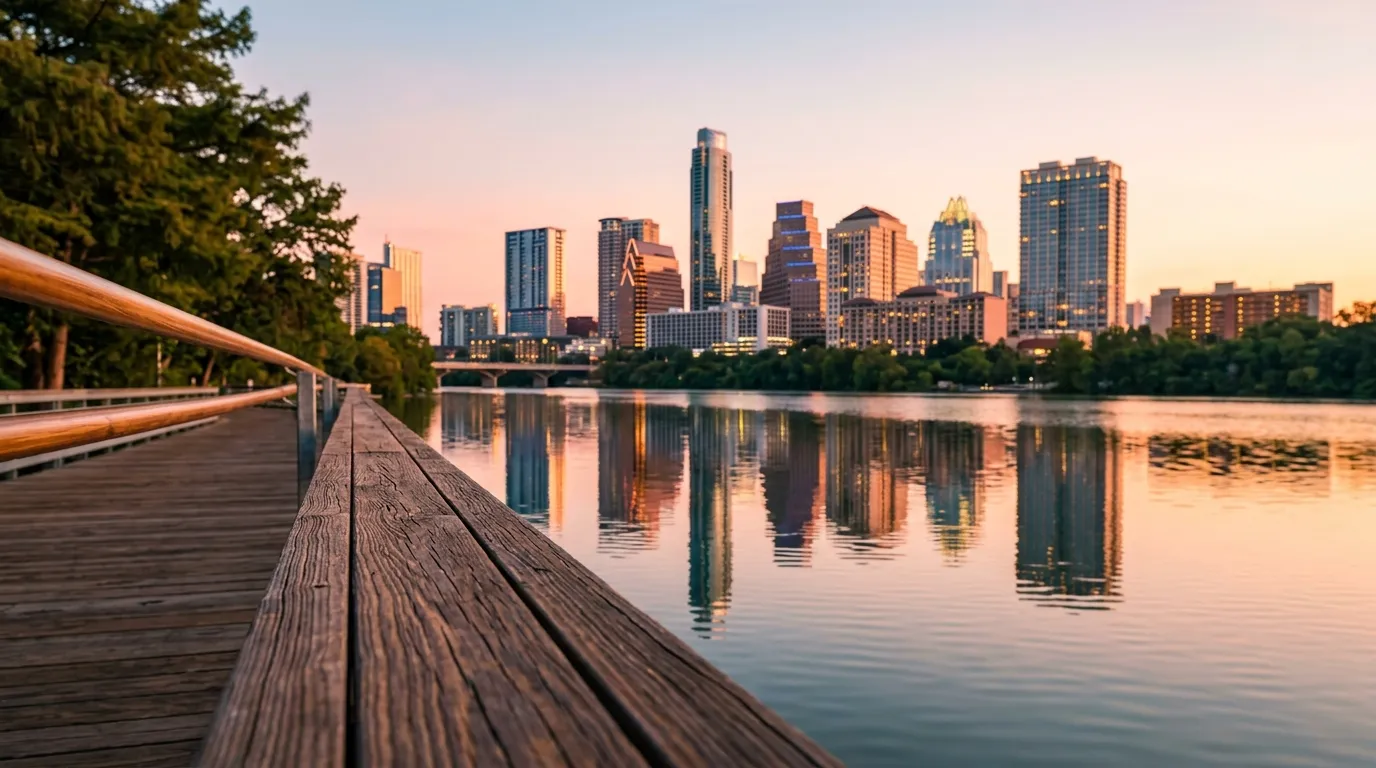
The Austin relocation conversation has changed since 2022. During the pandemic boom years, the pitch was simple: escape expensive coastal cities, pay less for more, no state income tax, tech jobs, warm weather. Today’s honest conversation is more nuanced — some of those advantages have compressed, new challenges have developed, and the city itself has changed in ways that matter depending on where you plan to live.
I’m William Zhang, a real estate agent with eXp Realty in Austin (TREC #811948). I’ve lived and worked in this market through the boom, the correction, and the current stabilization. Here is the actual pros and cons of living in Austin in 2026, based on what I see with clients every week — not a promotional pitch and not a doom narrative.
The Pros: What Austin Still Gets Right
Job Market Depth
Austin’s employment base has diversified beyond what most people realize. The tech anchors get the attention — Apple’s billion-dollar north Austin campus, Tesla’s Gigafactory in southeast Austin, Samsung’s semiconductor fab in Taylor, Oracle’s lakefront headquarters. But the metro also has a massive healthcare sector, UT Austin’s 50,000-student ecosystem, state government employment that does not fluctuate with private sector cycles, and a startup community that has attracted significant venture capital.
As of early 2026, Austin unemployment sits below the national average. The AI and semiconductor sectors are actively hiring. For tech workers, particularly those in software, hardware, or semiconductor fields, Austin offers an unusual combination of multiple major employers and lower cost of living than Bay Area or Seattle alternatives.
No State Income Tax — And It Still Matters
Texas levies no state income tax. For a household earning $200,000, that is roughly $15,000–$20,000 in savings compared to California, $10,000–$12,000 compared to New York. Property taxes are higher in Texas (more on that below), but for most working adults the net tax picture still favors Austin by a meaningful margin.
This is not a 2026 development — it has been true for decades. But it bears repeating because some relocation buyers have started discounting it after hearing about Austin’s higher property taxes. Run your personal numbers. For most households above median income, Texas wins the total tax comparison.
Outdoor Lifestyle That Holds Up
Austin has 300+ days of sunshine per year, access to the Texas Hill Country within 45 minutes, a robust running and cycling community, Lady Bird Lake and Barton Creek swimming, and Zilker Park as an urban green anchor. The Colorado River lakes (Lake Travis, Lake Austin, Lake Marble Falls) are 45–60 minutes from most of the metro.
Compared to most major American cities, Austin’s combination of urban access and outdoor proximity is genuinely strong. The caveat is that June through September outdoor activity requires early-morning timing — summer afternoons are not usable for most outdoor recreation. But spring and fall are exceptional, and mild winters mean outdoor activity is year-round if you plan around the heat window.
School Districts That Compete Nationally
Austin’s top suburban school districts compete with the best in the country. Eanes ISD (Westlake area) consistently places in the national top tier. Lake Travis ISD, Leander ISD, and Round Rock ISD all rank in Texas’s top 10–15%. Dripping Springs ISD punches above its size.
California transplants, in particular, are often surprised. The assumption that Texas schools are inferior to California schools does not hold at the school-district level for the Austin suburbs. The variability within Austin ISD is higher — some Austin ISD campuses are excellent, others are not — which is why verifying the specific attendance zone at your exact address matters more than the ISD name.
Austin’s Food Scene Has Arrived
Austin has always had BBQ (Franklin, la Barbecue, Terry Black’s) and Tex-Mex. What has changed in the last several years is the broader food scene. The Asian dining options — Korean, Vietnamese, dim sum, ramen, Japanese omakase — have expanded dramatically, partly driven by the tech worker population. East Austin’s fine dining corridor, South Congress’s restaurant strip, and the Domain area’s density all offer options that would not look out of place in Chicago or Los Angeles.
For people moving from food-centric cities, Austin now holds up in a way it did not in 2015.
The Cons: What Has Changed and What Was Always True
Home Prices Did Not Reset to Pre-2020 Levels
The Austin housing correction that began in mid-2022 brought prices down 15–20% from peak, but the metro median as of early 2026 sits around $400,000–$422,000 — roughly 50–70% above 2019 levels. The era of “affordable housing compared to anywhere” is gone for the central metro and most of the established suburbs.
You can still find meaningful value in the outer suburbs — Georgetown, Hutto, Kyle, Buda, and further-out communities in Williamson County — but those areas come with commute trade-offs that central Austin addresses do not. The value proposition is now “more affordable than coastal cities” rather than “affordable by any measure.”
Property Taxes Are a Real Number
The Texas property tax bill is not a footnote. On a $500,000 home in Austin ISD within Travis County, effective rates commonly produce a $10,000–$14,000/year bill before exemptions. Filing the homestead exemption (which every owner-occupant must do — it is not automatic) brings this down and caps annual assessment increases at 10%.
For buyers coming from California, where Prop 13 has capped many longtime homeowners at sub-1% effective rates, the Texas property tax is a genuine financial adjustment. For buyers from most other states where 1.5–2.5% is normal, it is less of a shock but still needs to be in the carrying-cost calculation.
The Heat Is Ten Weeks of Brutal
Austin summers are 10+ weeks of daily highs above 100°F with limited overnight cooling. This is not the “but it’s dry heat” version of hot — humidity adds to the discomfort from June through September. The practical impact on quality of life is real for people who enjoy outdoor activity, and the electric bills during this period are a significant household expense.
Traffic Has Not Been Solved
Multiple transportation projects have been underway for years, but Austin’s road infrastructure continues to lag population growth. I-35 through downtown remains dysfunctional at rush hour. MoPac is congested. Highway 183 has improved with managed lanes in some segments but remains heavily used.
The remote and hybrid work shift has helped — many Austin tech workers are in office two or three days per week rather than five, which meaningfully reduces peak commute impact. For workers with full five-day in-office requirements, commute quality is significantly neighborhood-dependent. The location decision matters more than the commute discussion in almost any other major metro.
Austin Has Changed — For Better and Worse
The city that attracted people five years ago was more affordable, less congested, and arguably had more of its original culture intact. The growth has brought density, national chains replacing local institutions, traffic, and a housing market that no longer feels accessible to entry-level professionals.
Whether that change matters to a specific buyer depends on what they are looking for. Families moving for schools, jobs, and space often find the Austin suburbs exactly right. Single professionals or couples who wanted Austin’s original music-and-BBQ character sometimes find the current version feels more like a version of every other Sun Belt growth city.
The most useful thing I can say about the pros and cons of Austin in 2026 is this: the gap between a great Austin experience and a frustrating one is almost entirely about neighborhood selection and commute management. People who chose their address based on lifestyle fit, school district, and realistic commute time are generally happy. People who bought based on price point alone, or Instagram aesthetics, often are not.
The Austin neighborhoods guide covers the major areas with current price data, school ratings, and commute context. The relocation guide has a broader overview for buyers still in the research phase. For active listings, lifeinaustintx.com lets you search by area and filter by price.
If you are working through the Austin decision and want a conversation grounded in current market reality rather than marketing copy, reach out directly. The honest version of this conversation is the one that actually helps you make a good decision.
Frequently Asked Questions
Is Austin Texas still worth moving to in 2026?
For most professionals and families, yes — particularly those relocating from high-tax states, tech workers with jobs in north Austin, and families prioritizing top-tier school districts. The trade-offs are real (summer heat, property taxes, traffic), but the job market, school quality, no state income tax, and relative housing affordability versus coastal metros keep Austin near the top of most relocation shortlists.
How has the Austin cost of living changed recently?
Austin is no longer the value play it was in 2018–2020. Home prices roughly doubled during the pandemic and have not fully corrected. The current median for the Austin metro sits around $400,000–$422,000 as of early 2026, down from the 2022 peak but still 50–70% above 2019 levels. Rent has come down from 2022 peaks — median rent in Austin proper is around $2,100/month — due to a wave of new apartment supply.
What is Austin's job market like in 2026?
Strong, especially in tech. Apple, Tesla, Samsung, Oracle, Dell, IBM, Google, Meta, Amazon, AMD, and Nvidia all have significant Austin presences. The AI and semiconductor sectors are expanding. Outside of tech, Austin has substantial healthcare (Ascension, Seton, Dell Seton Medical Center), state government, and UT Austin employment. The unemployment rate remains below the national average.
What are the best Austin suburbs for families in 2026?
Cedar Park and Leander (Leander ISD), Round Rock (Round Rock ISD), and Georgetown are consistently top-ranked for families. Dripping Springs (Dripping Springs ISD) and Bee Cave/Lakeway (Lake Travis ISD) are strong for families prioritizing Hill Country lifestyle. All of these have better school district ratings and lower entry prices than central Austin, with trade-offs in commute time to downtown.
How bad is Austin traffic in 2026?
Austin routinely ranks in the top 10 US cities for worst traffic relative to city size. I-35 through downtown remains the primary choke point, with MoPac and Highway 183 as overloaded alternatives. The worst corridors are I-35 between downtown and Round Rock, MoPac between Bee Cave Road and 183, and Highway 183 in the Rundberg and North Lamar areas. Remote and hybrid work has reduced but not eliminated the problem for most commuters.
Have questions about Austin real estate?
Reach out — I'm happy to help with your home search or sale.