Best New Construction Upgrades in Austin: Highest ROI
The design center appointment is where most Austin new construction buyers spend money they shouldn’t and skip upgrades they’ll regret.
I am a real estate agent in Austin, TX at eXp Realty (TREC #811948), and I have walked dozens of buyers through design center appointments at Lennar, Pulte, KB Home, Meritage, Coventry, and Taylor Morrison. The pattern is consistent: buyers spend heavily on things that can be changed cheaply later, and skip structural and electrical upgrades that become expensive — or impossible — to add after closing.
Here is how to think about upgrades in priority order.
Tier 1: Structural Upgrades — Do Not Skip These
Structural upgrades are the only category where “I can always do it later” is not true. Once the slab is poured, the footprint is fixed. Once framing passes inspection, adding structural elements requires demolition and new permits.
What falls into this category:
-
3-car garage — if the floor plan supports a tandem or third bay, this is one of the best resale differentiators you can buy in Austin. Tech workers with tools, motorcycles, and home gym setups want a third bay. Adding a garage bay after closing means structural demo, permit, and $40,000+.
-
Extended covered patio — Austin’s indoor-outdoor lifestyle is real. A covered patio that is 12x20 instead of 8x10 is a meaningful lifestyle improvement and a resale positive. Extending a patio after closing requires a permit and typically costs $15,000–$25,000. At the design center, the same extension might run $4,000–$8,000.
-
Bonus room / game room / media room — if the floor plan has an optional bonus room above the garage or a flex room option, this is worth the structural option cost. Finished square footage at builder cost is always cheaper than building out later.
-
Bedroom conversions — if the floor plan allows converting a flex space or study into a fourth bedroom (adding a closet, adjusting a door), do it at contract. Adding a closet to a room post-closing requires permits in most Austin jurisdictions.
The rule: anything that changes the exterior dimensions of the home, adds or removes load-bearing walls, or affects the foundation grade — add it at contract or not at all.
Tier 2: Electrical Pre-Wires — The Highest-ROI Upgrades in the Building
Electrical pre-wires are run during the rough-in phase when framing is open. At that stage, pulling a wire and setting a box costs the builder $50–$150 in labor. After drywall is up, the same wire run requires cutting walls, fishing wire, patching, repainting, and sometimes re-texturing — total cost $800–$2,500 depending on complexity.
Specific pre-wires worth adding:
-
EV charger circuit — a 240V circuit (NEMA 14-50 outlet) in the garage. At contract: $200–$400. After closing: $800–$2,000 plus electrician scheduling. If you do not own an EV today, someone who buys your home in 5 years probably will. This is a resale item now.
-
TV outlet above fireplace — a power outlet and low-voltage sleeve above the fireplace mount location so your mounted TV does not have a cord dangling down the wall. $150–$300 at contract. Impossible to do cleanly after drywall without a major patch.
-
Ethernet drops — one or two ethernet ports to the home office, primary bedroom, and any room you plan to use as a media room. WiFi is good. A wired connection is better, especially for remote workers and gamers. $200–$400 for 2–3 drops at rough-in.
-
Outdoor outlet on patio — if not standard, add it. This runs patio string lights, a refrigerator in the garage, holiday lights, or a power tool at the workbench. Cost at rough-in: under $100. After closing: a licensed electrician visit and drywall penetration.
-
Under-cabinet lighting rough-in — if you are upgrading the kitchen cabinets, ask whether the design center includes under-cabinet lighting pre-wire. If not, add it. Installing under-cabinet LED lighting without pre-wire is doable post-close but requires hiring an electrician and is messier.
Tier 3: Kitchen Upgrades — Strong Resale Return, but Prioritize Wisely
The kitchen is the highest-ROI room in any home. Austin buyers walking resale homes compare them directly to new construction kitchens — and a visibly entry-level kitchen on a resale home will cost you relative to comparables.
The priority order within kitchen upgrades:
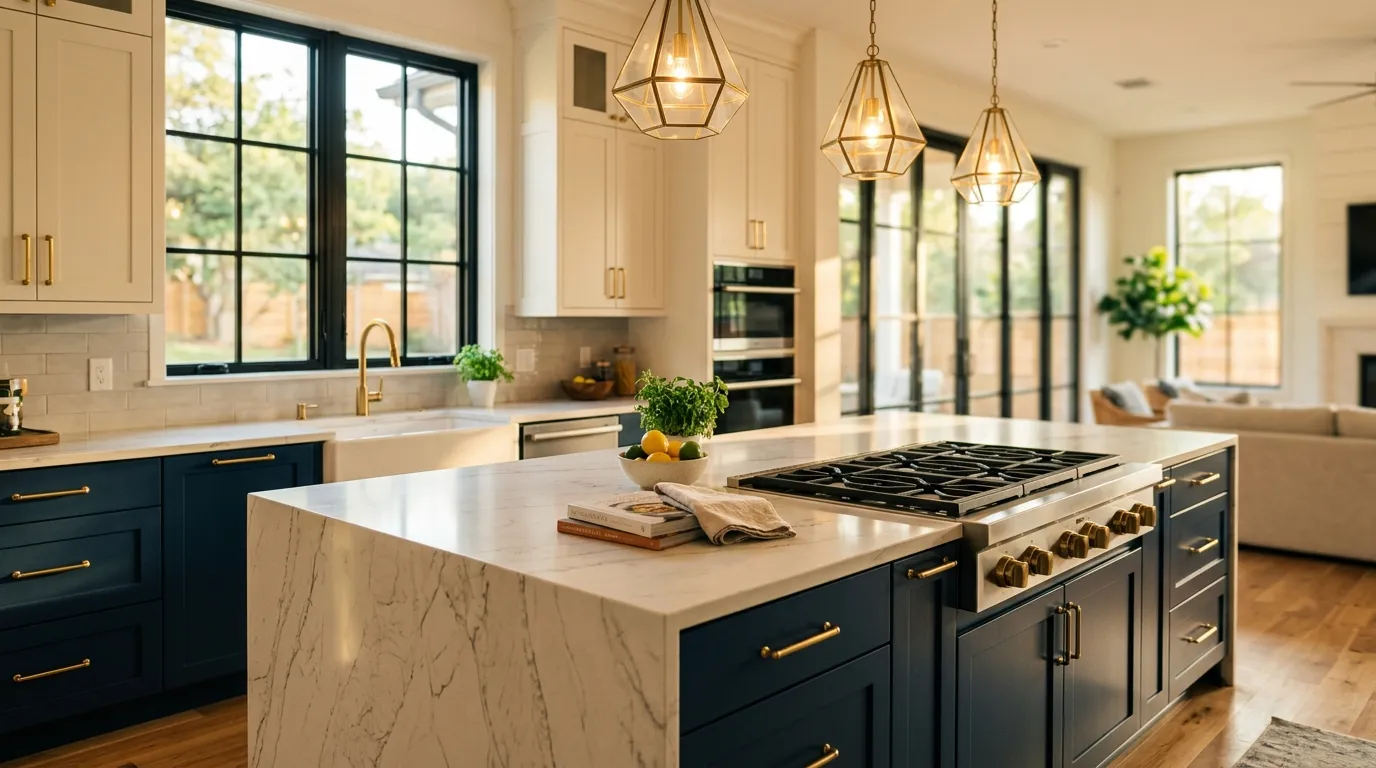
Countertops first. Upgrading from laminate (Level 1) to quartz (typically Level 3 at most Austin builders) is the single kitchen upgrade with the clearest resale return. Quartz countertops are now a buyer expectation at any price point above $350K in Austin. The design center upcharge for Level 1 to Level 3 countertops is typically $4,000–$9,000 depending on square footage. That same upgrade from a stone fabricator post-closing runs $5,000–$12,000 installed.
Cabinet color and hardware second. Painted cabinets (white, gray, navy) hold their value better than stained wood cabinets in the resale market right now. If the base cabinet is a medium-stain wood, upgrading to a painted finish is worth it. Hardware (pulls and knobs) can be swapped post-closing for $200–$400 in materials and an afternoon of your time — this is the definition of “do it later.”
Appliances carefully. Some builders (Lennar especially with their “Everything’s Included” model) build the appliance package into the base price. Others treat appliances as upgrades. If appliances are upgradeable, focus on the refrigerator and the range/oven — those are the items buyers notice. The dishwasher brand matters much less in a showing. Skip the builder’s refrigerator if you already own a quality one.
Backsplash tile last. Backsplash is the easiest and cheapest kitchen element to replace post-closing. A tile setter can replace a kitchen backsplash in a day for $800–$1,500 in materials and labor. Skip the design center backsplash upgrade and pick your own tile from an Austin tile supplier after closing.
Tier 4: Flooring — Upgrade Thoughtfully
Flooring is the most visible upgrade in a home tour, and the resale impact is real. But the design center markup on flooring is typically 20–40% above what you could pay at an independent flooring or tile supplier in Austin.
The honest framework:
If you plan to stay 5+ years: upgrade the main living areas to at least Level 2 or 3 LVP or tile. Living with Level 1 vinyl or carpet in the main areas for years is annoying and weakens resale over time.
If you plan to move in 3–5 years: seriously consider taking the base flooring, saving $5,000–$8,000 at the design center, and putting that money toward flooring at an independent supplier post-closing — or into closing costs. You will get better material quality, more design options, and a competitive price.
Where to upgrade and where not to:
- Main living, kitchen, and dining areas: upgrade to hard surface (LVP or tile), never stay on base carpet in these rooms if budget allows
- Primary bedroom: padded carpet is actually the right choice — buyers and owners both prefer carpet in bedrooms, and the padded carpet upgrade ($800–$1,200 for a primary bedroom) is worth it for daily comfort
- Secondary bedrooms: base carpet is fine
- Bathrooms: base tile is usually acceptable; upgrading to a larger tile format (12x24 instead of 12x12) has visual impact at a modest cost
Tier 5: Vaulted and Raised Ceilings
Vaulted ceilings and 10-foot ceilings where the standard is 9-foot are meaningful upgrades that buyers notice and appraisers value. Most production builders in Austin offer 8-foot or 9-foot standard ceiling heights with options to raise to 10-foot or 11-foot in the main living area.
The math works: a vaulted or raised ceiling creates visual volume that is genuinely difficult to replicate post-closing (it requires structural work and a permit). Design center pricing is typically $2,000–$5,000 for a main-level ceiling height upgrade. That ROI is solid.
This is also where the floor plan comparison becomes important. Pulte’s Horizon Lake in Leander already has a 12-foot beamed ceiling in the Nelson plan standard — meaning you are not paying extra for the volume. Taylor Morrison communities often have raised ceilings standard in their larger plans. Check what is standard before upgrading.
What to Skip Entirely
Design center lighting fixtures. The builder’s fixture allowance is typically Level 1 fixtures from a limited catalog. Upgrading within the design center catalog still gets you builder-marked-up fixtures. Better move: take whatever credit the design center offers for “builder standard” fixtures and buy your own from Ferguson, Wayfair, or a local Austin lighting showroom after closing. You will get better fixtures at lower cost.
Window treatments. Builder-installed blinds and shutters are almost always cheaper from an independent installer. After closing, call a local shutter company, get three bids, and pick the finish you actually want. The design center’s markup on window treatments is aggressive.
Extended warranty packages. Some builders offer extended warranties beyond the standard 1/2/10 coverage. Evaluate these carefully — the 1-year workmanship / 2-year systems / 10-year structural coverage required by Texas law already covers the major risk categories. Extended warranty packages often have significant exclusions.
Putting It Together: Budget Allocation
Here is a practical framework for a $500K Austin new construction home:
- Structural options (covered patio, 3rd garage bay, room conversion if available): allocate up to $15,000
- Electrical pre-wires (EV circuit, TV above fireplace, ethernet): $500–$1,000 — spend it all
- Countertops (Level 1 to Level 3 quartz): $5,000–$9,000 — worth it
- Cabinet upgrade (if base is a finish you dislike): $3,000–$6,000
- Flooring in main living areas (LVP or tile upgrade from base carpet): $4,000–$8,000
- Primary bedroom padded carpet: $800–$1,200
- Ceiling height upgrade (if available in main living area): $2,000–$5,000
Total: $15,000–$45,000 above base price. This is normal for an Austin new construction home — budget accordingly when comparing builder prices to resale prices.
For a full breakdown of communities where you can apply this framework right now, see the Austin new construction hub and the new construction buyer’s guide. If you want to talk through design center strategy for a specific builder appointment, reach out directly — I can walk you through what matters at each builder before you sit down at the design center.
Browse active new construction listings at lifeinaustintx.com to see current inventory across Austin-area builders.
Frequently Asked Questions
What is the most important upgrade to get in a new construction home?
Structural upgrades — things like an extended covered patio, a third-car garage bay, a bonus room, or a bedroom conversion — are the most important because they cannot be added after the slab is poured. Electrical pre-wires (EV charger circuit, outlet above fireplace, data drops) are a close second. Cosmetic upgrades like countertops and flooring can be replaced later at your cost, but structural changes after closing require permits, demolition, and significant expense.
Should I upgrade flooring in a new construction home in Austin?
Flooring is worth upgrading from base level if you are planning to stay 5+ years, because replacing flooring after closing means coordinating around your furniture and life. However, the builder's design center markup on flooring is often 20–40% above what you could pay at an independent tile or flooring supplier. If you plan to replace flooring within 3 years anyway, negotiate a flooring allowance or skip the upgrade and source it yourself after closing.
Is the kitchen upgrade worth it in a new construction Austin home?
The kitchen upgrade has the strongest resale return of any interior upgrade. Buyers shopping your home in 3–5 years will compare your kitchen to new construction kitchens they've toured. If your cabinets, countertops, and backsplash are visibly entry-level, it will cost you on resale. Upgrading to a Level 3 countertop (quartz) and a Level 2–3 cabinet is usually worth the design center cost. The backsplash tile is lower priority — it's a smaller visual impact and easier to replace later.
What electrical upgrades are worth adding at contract?
Pre-wires that are expensive to add after drywall: an EV charger circuit (240V NEMA 14-50 in the garage) for $200–$400 at contract versus $800–$2,000 post-closing; a TV pre-wire and outlet above the fireplace for cleaner mounting; structured wiring panel with ethernet runs to bedrooms and office for $300–$600. These are mechanical add-ons with permanent value that cost very little during framing.
What new construction upgrades should I skip?
Lighting fixture upgrades from the builder's design center are typically overpriced — builders mark up fixtures 30–50% above retail. Buy from the design center if you want a credit against what's included, but spec the lights yourself from a retail source if you want a specific fixture. Baseboard upgrades from 3.5-inch to 5.25-inch are a small visual difference for a meaningful design center upcharge. Window treatments (blinds, shutters) from the builder are almost always cheaper from a local installer post-closing.
Have questions about Austin real estate?
Reach out — I'm happy to help with your home search or sale.