New Construction Homes in Austin, TX: The 2026 Buyer's Guide
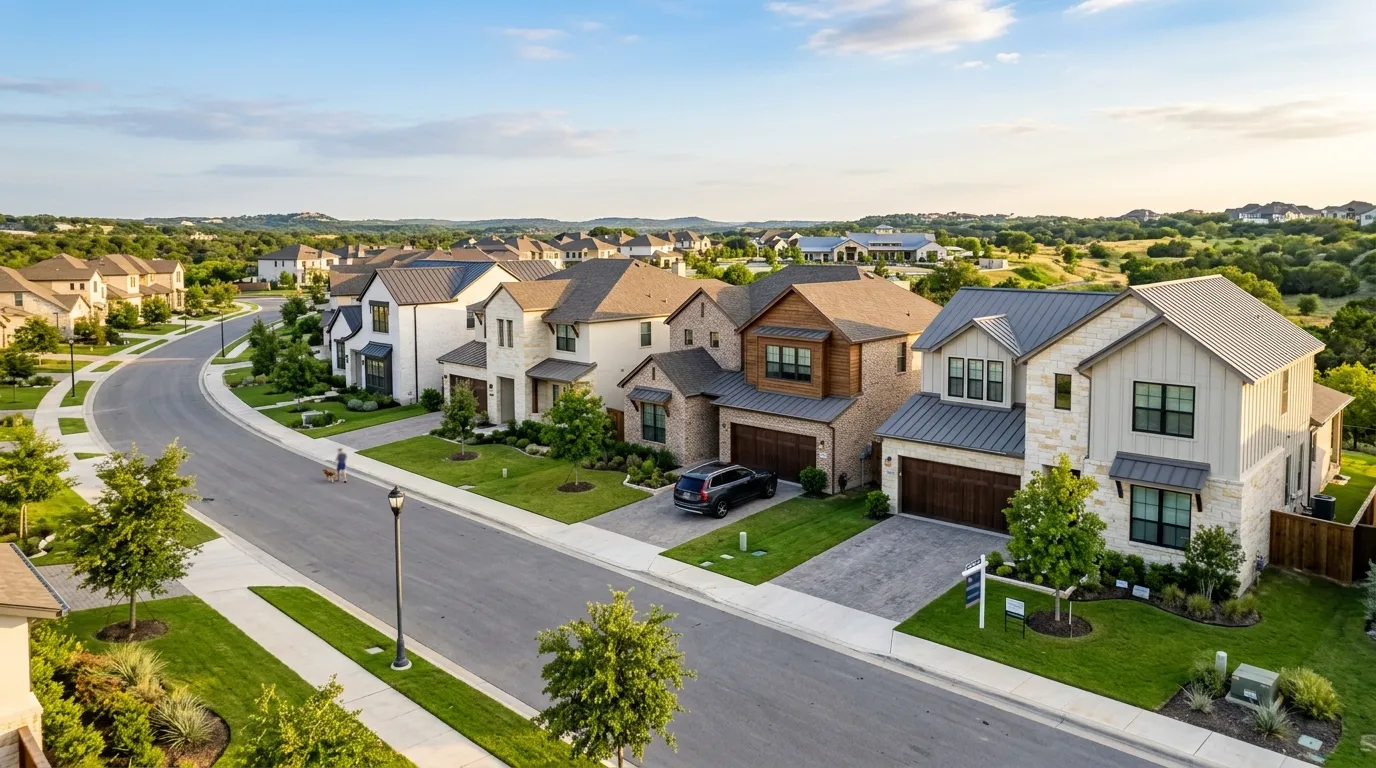
New construction homes are one of the biggest segments of the Austin real estate market. In 2026, with existing-home inventory still recovering and builders offering aggressive incentives to move inventory, new construction deserves a serious look from buyers — especially first-time buyers, relocation buyers, and anyone who wants a low-maintenance home with modern features.
As a local Austin real estate agent who represents buyers at every major builder in the metro, here’s the complete guide to buying new construction in Austin.
The Biggest Mistake New Construction Buyers Make
Before anything else: do not walk into a builder’s sales office alone.
The friendly person behind the desk works for the builder, not you. Their job is to sell the builder’s inventory at terms that benefit the builder. If you sign anything — even a sign-in sheet — without having a buyer’s agent registered, you may lose the ability to bring one in later at that community.
The fix is simple: before your first visit, text or call a buyer’s agent and ask them to register you with that builder. It takes 60 seconds. It’s free to you (builders pay buyer-agent commissions out of their marketing budget in almost all cases). And it gives you an advocate for the rest of the process.
Major Austin-Area Builders
Austin has more active production builders than almost any metro in the country. Here are the biggest players:
Large production builders (entry-level to mid-range, typically $300K-$700K)
- Lennar
- DR Horton
- Pulte Homes / Del Webb
- Meritage Homes
- KB Home
- Taylor Morrison
- Brohn Homes
Mid-to-premium production ($400K-$1M+)
- Perry Homes
- Highland Homes
- David Weekley Homes
- Ashton Woods
- Chesmar Homes
- Scott Felder Homes
- Coventry Homes
- Castlerock Communities
Semi-custom and custom ($700K-$3M+)
- Drees Custom Homes
- Trendmaker
- Partners in Building
- Sitterle Homes
- Dozens of local custom builders serving Westlake, Barton Creek, Lakeway, and Dripping Springs
Each builder has its own contract, incentive structure, warranty terms, and reputation. A buyer’s agent who works across all of them knows the quirks.
Where New Construction Is Happening
Most new construction activity is in the outer suburbs where land is still available and relatively affordable:
North / Northwest:
- Leander & Liberty Hill — fast-growing, top-rated Leander ISD schools, heavy new build activity, popular with families
- Cedar Park — more limited new construction (mostly infill), but some new communities
- Georgetown — historic downtown plus large new communities, Sun City retirement area, strong appreciation
Northeast:
- Hutto — entry-level pricing, growing fast, close to Samsung Taylor and Tesla Gigafactory
- Manor — value pricing, growing industrial corridor
- Pflugerville (north) — newer communities, good value
South:
- Kyle & Buda — south metro value plays, rapid growth
- Dripping Springs — Hill Country lifestyle, luxury and semi-custom, Dripping Springs ISD
West:
- Lago Vista & Jonestown — Lake Travis views at more accessible prices
- Spicewood — luxury and custom builds
Central Austin and close-in neighborhoods (South Congress, Tarrytown, East Austin, Mueller) have very little new construction — mostly infill teardown-and-rebuild projects plus the occasional condo tower.
Pricing: What You Actually Pay
Builder list pricing is almost never the full story. Here’s what goes into the actual cost of a new construction home:
- Base price — the starting point for the smallest floor plan on the least desirable lot
- Lot premium — $5,000-$100,000+ for better lots (greenbelt, corner, cul-de-sac, view, oversized)
- Structural options — bonus rooms, extra bedrooms, 3-car garage, covered patio (these can only be added at contract signing)
- Design center upgrades — flooring, countertops, cabinets, paint, fixtures, appliances (can easily add 10-20% to base)
- Closing costs — lender fees, title, survey, HOA setup, prorated taxes
- Optional upgrades at closing — window coverings, appliances if not included, landscaping
A home advertised at $450K can easily become $550K-$600K by the time you have a livable finished home. Budget accordingly.
How to Actually Negotiate with Builders
Builders rarely move on base price — that would affect comparables for every other home in the community. Instead, they negotiate through incentives:
- Closing cost contributions (commonly $5,000-$15,000)
- Design center credits ($5,000-$25,000 toward upgrades)
- Rate buydowns through their preferred lender (2-1 or 3-2-1 buydowns can save you thousands in early years)
- Upgrade packages (appliances, blinds, fence, landscaping)
- Flex credits you can apply however you want
- Move-in ready specs — already-built homes are often the most negotiable because the builder is carrying the cost
An experienced buyer’s agent who sees these offers across multiple builders monthly knows what’s normal vs generous. On a typical $500K Austin new home, total builder incentives often reach $15,000-$30,000. Sometimes more on spec homes.
The MUD Problem Nobody Talks About
Many Austin-area new construction communities are located in Municipal Utility Districts (MUDs). A MUD is a special taxing district created to fund water, sewer, drainage, and roads in new developments.
MUDs add an extra property tax rate — typically 0.5% to 1.0% — on top of city and school district rates. In MUD areas, your total property tax rate can easily hit 2.8% to 3.2% of assessed value. On a $500K home, that’s an extra $2,500-$5,000 per year compared to a non-MUD area.
Texas law requires builders and sellers to provide a MUD disclosure before closing, but many buyers don’t fully understand what they’re signing. Always ask:
- Is this community in a MUD?
- What’s the current MUD tax rate?
- When is the MUD debt projected to be retired? (Rates typically decrease over time.)
- Are there any other special districts or assessments (PIDs, SUDs)?
First-Year Property Tax Surprise
Here’s the other big one. Your first-year property tax estimate on a new construction home is based on the unimproved lot, not the finished home. Your Year 2 tax bill — the actual number you’ll pay long-term — will be 2-3 times higher than your Year 1 estimate.
Always ask your builder for an estimated Year 2 property tax number and use that for your long-term budget. Many buyers budget off the Year 1 number and get crushed the following year.
The Builder’s Lender: Should You Use Them?
Builders typically offer meaningful incentives if you finance through their preferred lender — commonly $5,000-$15,000 in closing cost contributions or rate buydowns. That’s real money.
But the preferred lender’s rate or fees may not be the best available. To actually compare:
- Get a Loan Estimate from the builder’s lender
- Get a Loan Estimate from at least one outside lender (a local credit union or mortgage broker is usually competitive)
- Compare total cost over 3-5 years, including the builder incentive
- Pick whichever is cheaper on net
Sometimes the builder’s lender wins. Sometimes they don’t. Always shop.
Inspections: Yes, You Need Them
“It’s brand new — why would I need an inspection?”
Because even brand-new homes have issues. Framing mistakes, plumbing errors, HVAC sizing problems, roofing defects, wrong fixtures, crooked tile, missing insulation. I’ve been through hundreds of new construction inspection reports and every single one has findings.
I recommend three inspections on new construction:
- Pre-drywall inspection — before insulation and drywall cover the framing, plumbing, electrical, and HVAC runs. This is the most important inspection you’ll do. Roughly $400-$600.
- Final inspection — before closing, after everything is finished. Another $400-$600.
- 11-month warranty inspection — scheduled right before the builder’s 1-year workmanship warranty expires. Any issues found get submitted under warranty at no cost. Roughly $400-$600.
Total: $1,200-$1,800 for three inspections. Easily the best return on investment in the process.
New Construction vs Resale in Austin
| Factor | New Construction | Resale |
|---|---|---|
| Floor plan | Modern, open | Varies, often dated |
| Energy efficiency | Generally better | Varies significantly |
| Maintenance | Low (builder warranty) | Higher initially |
| Location | Outer suburbs | Established neighborhoods, close-in |
| Lot size | Often smaller | Varies, often larger mature lots |
| Trees & landscaping | None or new | Mature |
| Schools | Sometimes still being built | Established |
| Price negotiation | Via incentives | Via price directly |
| Property tax Year 2 | Often higher (new build + MUD) | Based on existing assessment |
| Move-in speed | 30-60 days (spec) or 5-9 months (build) | 30-45 days |
| Character | Uniform, similar neighbors | Variable |
There’s no universal right answer. For relocation buyers on a tight timeline who want modern features, new construction is often the best fit. For buyers prioritizing location, mature trees, and established schools, resale usually wins.
How to Actually Start Buying New Construction in Austin
- Get pre-approved with a lender. Know your budget before you walk into a sales office.
- Shortlist 3-5 builders and communities based on your budget, commute, and school preferences.
- Register a buyer’s agent (ideally me) before your first visit to any community.
- Tour with your agent. We’ll ask about current incentives, lot availability, timeline, and MUD status at each stop.
- Compare apples to apples. Factor in base price, lot premium, structural options, design center estimates, and Year 2 taxes.
- Negotiate incentives before signing. Once you sign, most leverage is gone.
- Get a pre-drywall inspection during construction.
- Get a final inspection before closing.
- Close and move in.
- Schedule the 11-month warranty inspection so you can submit any issues under warranty.
Frequently Asked Questions: Austin New Construction
Q: Are new construction homes in Austin still in demand? Yes, but the market has cooled from 2021-2022. Builders are offering more incentives and negotiating more than they were a few years ago. For buyers, this is a better time to buy new construction than it’s been in years.
Q: What’s the cheapest new construction in the Austin area? Entry-level production homes in Hutto, Manor, Kyle, Buda, and Liberty Hill start in the mid-$300Ks for 3-4 bedroom homes around 1,800-2,200 sq ft.
Q: What’s the nicest new construction in Austin? Luxury semi-custom and custom builders serve Westlake, Lakeway, Barton Creek, Dripping Springs, and parts of Spicewood. Prices range from $1.5M to well over $5M for estate-level homes on acreage.
Q: Is new construction in Austin a good investment? Depends on location, price, and holding period. Resale value on a brand-new home in a master-planned community is generally tied to the success of that community — the first phase often appreciates the most. For a 5-10 year hold in a desirable area, new construction has historically performed well.
Q: How do I know if a builder is reputable? Check BBB ratings, read Google reviews of specific communities (not just the builder in general), look up the specific build quality complaints online, and ask your buyer’s agent about builder reputation. Good agents have seen enough inspection reports to know which builders consistently deliver quality and which cut corners.
Ready to Tour New Construction in Austin?
If you’re thinking about new construction in Austin, let’s talk before you visit any sales offices. I’ll help you shortlist the right builders and communities, register you correctly, and represent you through the entire process — at no cost to you. Call or text (512) 766-3188, or get in touch here.
For broader context, see my new construction homes in Austin hub page, my buy a home in Austin guide, or my Austin neighborhood guides to narrow down where you want to land.
Frequently Asked Questions
Are new construction homes in Austin a good deal in 2026?
Yes, 2026 is one of the best years to buy new construction in Austin in over a decade. Builders are offering aggressive incentives — closing cost contributions of $5,000–$15,000, design center credits up to $25,000, rate buydowns to the 4–5% range, and bonus upgrades — to move inventory built during the 2021–2022 boom. On a typical $500K Austin new home, total builder incentives often reach $15,000–$30,000.
Where can I find the cheapest new construction homes in the Austin area?
Entry-level new construction starts in the mid-$300Ks for 3–4 bedroom homes around 1,800–2,200 sq ft in Hutto, Manor, Kyle, Buda, and Liberty Hill. These outer suburbs offer the best price per square foot for new builds, though commute times to downtown Austin can reach 35–50 minutes. Pflugerville and Leander are mid-tier value plays in the high $300s to mid $400s.
Should I use a buyer's agent when buying a new construction home in Austin?
Yes, always. The builder's sales rep represents the builder, not you, and won't negotiate on your behalf. A buyer's agent commission is typically paid by the builder out of their marketing budget, so it costs you nothing. The critical step is registering your agent before your first visit to any sales office — once you sign in alone, you may lose the ability to bring representation in later.
What is a MUD tax in Austin and how much does it add to property taxes?
A Municipal Utility District (MUD) is a special taxing district that funds water, sewer, drainage, and roads in new master-planned communities. MUDs add an extra 0.5%–1.0% to your property tax rate, pushing total rates in MUD areas to 2.8%–3.2% of assessed value. On a $500,000 home, that's an extra $2,500–$5,000 per year compared to a non-MUD area. Always ask the builder if a community is in a MUD before signing.
What inspections do I need on a new construction home in Austin?
Three inspections are recommended on Austin new construction: a pre-drywall inspection (~$400–$600) before insulation covers framing and plumbing, a final inspection (~$400–$600) before closing, and an 11-month warranty inspection (~$400–$600) before the builder's 1-year workmanship warranty expires. Total cost of $1,200–$1,800 is the best ROI in the home buying process — every new home has findings.
How much do property taxes go up in year 2 on new construction in Austin?
Year 1 property taxes on a new construction home are based on the unimproved lot, while Year 2 reflects the finished home value. The Year 2 tax bill is typically 2–3 times higher than the Year 1 estimate. On a $500,000 new home, Year 1 might be $3,000–$5,000 and Year 2 jumps to $9,000–$14,000. Always budget off the Year 2 number, not the builder's Year 1 quote.
Can I negotiate the price of a new construction home in Austin?
Builders rarely move on base price because that would affect comparables for every other home in the community. Instead, they negotiate through incentives: closing cost contributions ($5K–$15K), design center credits ($5K–$25K), rate buydowns (2-1 or 3-2-1), free upgrade packages, and lot premium waivers. Spec homes (move-in ready inventory) are usually the most negotiable because the builder is carrying the holding cost.
Should I use the builder's preferred lender in Austin?
Sometimes. Builders typically offer $5,000–$15,000 in closing cost incentives or rate buydowns if you finance through their preferred lender. To know if it's worth it, get a Loan Estimate from the builder's lender and at least one outside lender (a local credit union or mortgage broker), then compare total cost over 3–5 years including the incentive. Sometimes the builder's lender wins, sometimes it doesn't.
Who are the major new construction builders in Austin, Texas?
Major Austin production builders include Lennar, DR Horton, Pulte Homes, Meritage Homes, KB Home, Taylor Morrison, and Brohn Homes for entry-level to mid-range ($300K–$700K). Mid-to-premium builders include Perry Homes, Highland Homes, David Weekley, Ashton Woods, and Chesmar Homes. Custom and semi-custom builders like Drees, Trendmaker, and Sitterle serve the Westlake, Lakeway, and Dripping Springs luxury market.
How long does it take to build a new home in Austin?
A built-to-order new construction home in Austin typically takes 5–9 months from contract signing to closing, depending on builder, complexity, and material availability. Spec homes (already built or under construction) can close in 30–60 days, which is why builders offer the deepest incentives on inventory homes. Relocation buyers on a tight timeline almost always pick spec homes for speed.
Is new construction or resale better for buying in Austin?
New construction is better for relocation buyers on a tight timeline who want modern features, energy efficiency, and low maintenance — typically in outer suburbs like Leander, Pflugerville, Hutto, or Kyle. Resale is better for buyers who prioritize location, mature trees, larger established lots, and proven schools — typically in close-in neighborhoods like Cedar Park, Round Rock, Westlake, or central Austin. Neither is universally right.
What's the biggest mistake people make buying new construction in Austin?
The biggest mistake is walking into a builder's sales office alone without a buyer's agent registered. Once you sign in solo, you may lose the ability to bring representation in later, which means losing tens of thousands in negotiation leverage on incentives, upgrades, and lot selection. The fix takes 60 seconds: text or call a buyer's agent before your first visit and have them register you with the builder.
Have questions about Austin real estate?
Reach out — I'm happy to help with your home search or sale.