Most Walkable Neighborhoods in Austin (2026 Buyer's Guide)
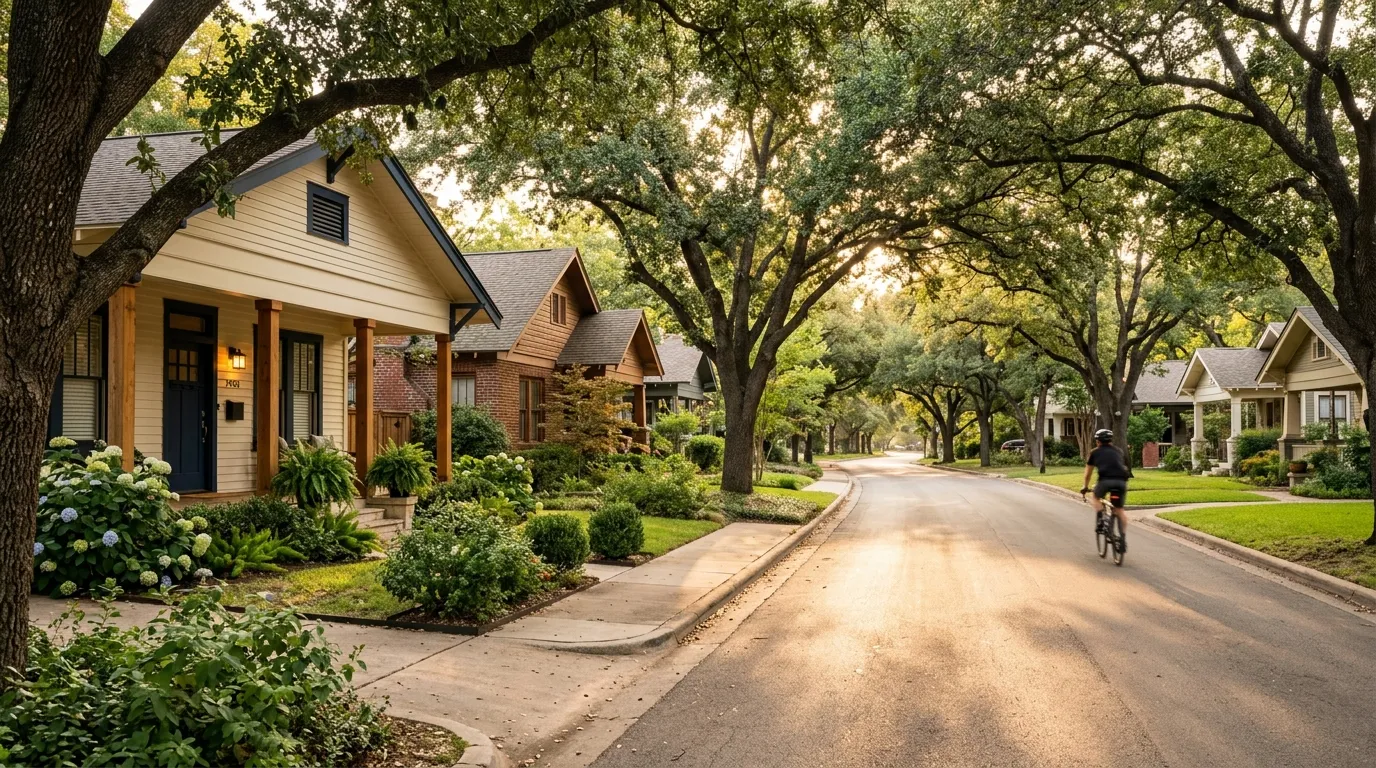
Bottom line: Austin’s most walkable neighborhoods in 2026 are Downtown (Walk Score 94), Clarksville, East Cesar Chavez, Hyde Park, Mueller, and the Bouldin/South Congress corridor. These six areas concentrate Austin’s bars, restaurants, coffee shops, grocery stores, and parks within walking distance of housing. The trade-off is price — walkable Austin neighborhoods typically cost 15% to 30% more per square foot than equivalent non-walkable homes. Downtown lets you live without a car; the others let you live with one and use it less. This guide breaks down each neighborhood’s vibe, price range, schools, and the daily lived experience, so you can pick the one that fits.
William Zhang is an Austin real estate agent with eXp Realty (TREC #811948). Walkability is one of the most-requested filters for buyers moving to Austin from coastal cities — and one of the hardest to evaluate from outside because Walk Score numbers do not always match lived experience. This guide is based on actually walking these neighborhoods, not just reading the data.
The Short Version
| Neighborhood | Walk Score | Vibe | Median Home Price (2026) | Best For |
|---|---|---|---|---|
| Downtown | 94 | Urban condo, nightlife, work | $550K to $1.5M+ condos | Singles, couples, urban professionals |
| Clarksville | mid-80s to 90s | Historic, quiet, tree-lined | $1.2M to $2.5M | High-end buyers wanting quiet walkability |
| East Cesar Chavez | high 80s | Trendy, restaurants, music | $600K to $1.2M | Young professionals, creatives |
| Hyde Park | 78 | Quiet, historic, families | $650K to $1.5M | Families, professors, established professionals |
| Mueller | low-mid 70s (lived: 85+) | Planned, mixed-use | $700K to $1.1M | Families, design-forward buyers |
| Bouldin/South Congress | high 70s | South Austin, eclectic | $750K to $1.5M | Buyers who want SoCo lifestyle |
| Travis Heights | mid-70s | Tree-lined, near Town Lake | $800K to $1.5M | Established buyers near Lady Bird Lake |
| North Loop | high 70s | Eclectic, affordable | $475K to $850K | Younger buyers wanting walkability on a budget |
Why Walkability Matters in Austin
Austin grew from 250,000 people in 1980 to nearly 1 million in 2026 in a metro that hit 2.4M, and most of that growth happened as car-oriented suburban sprawl. Cedar Park, Round Rock, Leander, Pflugerville, Kyle, Manor, and Hutto are all functionally car-dependent — meaning the average daily activity requires at least one car trip.
A small cluster of central neighborhoods bucks that pattern. These are the neighborhoods that pre-date the post-1980 boom or were master-planned with walkability as a design goal. Living in one of these areas changes daily life in concrete ways:
- Daily walking distance shrinks decision overhead for restaurants, coffee, groceries, and small errands.
- Lower car dependency can save $5,000 to $10,000 per year for a one-car household versus two-car.
- Higher home appreciation over time — walkable Austin neighborhoods have historically outperformed the metro average by 100 to 200 basis points annually.
- Easier resale because walkability is a top-3 buyer criterion that does not change.
The downside is cost. Walkable neighborhoods are scarce, demand is high, and per-square-foot pricing reflects that. For most buyers, the trade-off is more square footage in a non-walkable suburb versus less square footage in a walkable urban neighborhood at the same monthly payment.
Downtown Austin
Walk Score: 94 (top in metro).
Downtown Austin is the densest, most pedestrian-friendly part of the city by any measure. Bars, restaurants, coffee shops, live music venues, grocery stores (HEB at 6th and Lavaca, Royal Blue Market on Congress), parks (Republic Square, Ladybird Lake trails), and offices line 4th, 5th, 6th, and Congress. Most daily needs are within a 5- to 10-minute walk.
Housing: Almost entirely condos and high-rises. The Independent, Austonian, 360, 70 Rainey, the Travis, Seaholm, the Bowie, the Linden, and the Manse all sit downtown. Older buildings (Brown, Brazos Lofts) start around $400K for a studio. Newer high-rises like the Independent and 70 Rainey run $650K for a one-bedroom and $1.5M+ for larger units.
Lifestyle: Live music seven nights a week, 30+ coffee shops, every major restaurant group represented, easy access to Ladybird Lake trails, runners’ culture along the river. Downtown is the only Austin neighborhood where a no-car lifestyle is genuinely practical.
Trade-offs: Higher HOA fees (typically $600 to $1,500/month), 6th Street weekend noise if you are on a low floor or facing the wrong direction, no yard, limited single-family option. Property taxes are calculated on the city limits in AISD — the 2.07% standard rate. See the Austin property tax guide for the full picture.
Best for: Singles, young couples, urban professionals, second-home buyers, recent retirees wanting to ditch the car.
Clarksville
Walk Score: mid-80s to low 90s in some pockets.
Clarksville is one of Austin’s oldest neighborhoods, just west of Downtown along West Lynn Street between MoPac and Lamar. It is small — maybe 30 blocks — and consists mostly of historic single-family homes on tree-lined streets, with a tight commercial corridor along West Lynn (Café Medici, Jeffrey’s, Josephine House, Clark’s Oyster Bar, Wink, Galaxy Cafe).
Housing: Mostly single-family bungalows and historic homes, some new infill. Prices in 2026 run $1.2M to $2.5M for single-family. Smaller cottages occasionally come on market in the high $900Ks.
Lifestyle: Quieter than Downtown but still walkable to dinner, coffee, and weekend errands. Strong professional-class demographics, dog parks, a deeply established community. Lady Bird Lake trails are a 5-minute walk south.
Trade-offs: Limited inventory — typically 5 to 15 active listings at any time. Older homes often need updates. Hot in summer because of mature trees that block AC efficiency.
Best for: High-end buyers who want quiet walkability, downsizers from larger central Austin homes, professionals wanting Austin’s most established neighborhood.
East Austin (East Cesar Chavez, East 6th, Manor Road)
Walk Score: mid-70s to high 80s depending on block.
East Austin is the city’s most rapidly transformed neighborhood. The walkable section — roughly East Cesar Chavez through East 7th and over to Manor Road — has the highest density of trendy restaurants, coffee, music venues, and small shops outside of Downtown. East Cesar Chavez specifically is one of the most walkable Austin neighborhoods outside Downtown.
Housing: Mix of historic small homes (often 1,000 to 1,400 sqft on small lots), modern infill new construction, and condo developments. Prices run $600K to $1.2M for single-family, with new construction at the top of that range. Condos and townhomes start in the high $400Ks.
Lifestyle: Strong food and music scene. Coffee at Cuvée or Better Half, dinner at Suerte or Bufalina, music at Hotel Vegas. Easy access to Downtown by bike or short ride. Mexic-Arte Museum, the East Side Pickle, and other neighborhood culture anchors.
Trade-offs: Walkability drops sharply once you go east of Pleasant Valley. Some blocks have rapid gentrification tensions. School options are mixed (Sanchez Elementary, Govalle Elementary).
Best for: Young professionals, creatives, designers, couples without school-age kids, anyone prioritizing food and music access.
Hyde Park
Walk Score: 78 (lived experience is higher).
Hyde Park is Austin’s historic streetcar suburb — laid out in the 1890s as one of the first planned subdivisions in the city. It runs roughly from 38th Street north to 51st Street, between Lamar and Duval. The signature is tree-lined streets, modest historic homes, and small commercial pockets along Duval and 38th-1/2 Street.
Housing: Bungalows, craftsman homes, mid-century houses on small to medium lots. Prices run $650K to $1.5M for single-family. Some renovated homes push above $1.5M. Smaller condos and duplexes are occasionally available in the high $400Ks to $700Ks.
Lifestyle: Quiet, family-friendly, walkable to coffee (Quack’s, Bennu, Mozart’s nearby), small restaurants (Eldorado Cafe, Asti, Hyde Park Bar & Grill), Hyde Park Theatre, and small neighborhood shops. Strong community feel with annual block parties and a long-established residents’ association.
Trade-offs: Older homes with smaller closets and dated mechanicals. Limited inventory. UT-area parking sometimes spills in.
Best for: Families, professors, established professionals, anyone wanting walkability without Downtown noise.
Mueller
Walk Score: low-mid 70s (lived experience is closer to 85+).
Mueller is Austin’s master-planned showcase neighborhood, built on the former Mueller Airport site in east-central Austin. Construction started in 2007 and the neighborhood is now nearly built out. The design philosophy: walkable streets, mixed-use retail along Aldrich and East Anderson, parks every few blocks, the Thinkery children’s museum, and a lake-and-trail system.
Housing: Mix of single-family (yards facing alleys, garages off the alley), townhomes, row houses, condos, and apartments. Prices run $700K to $1.1M for single-family, $500K to $850K for townhomes. Affordable housing component is in place — some homes are deed-restricted to lower price points.
Lifestyle: Highly walkable to HEB, restaurants (L’Oca d’Oro, Halcyon, Vamonos), the Thinkery, Mueller Lake, dog parks, and small shops. Weekly farmers market, summer concerts, holiday events. Mueller has its own community vibe distinct from the rest of Austin.
Trade-offs: Newer construction means smaller lots and tighter setbacks. Some buyers find the planned-community aesthetic too uniform. HOA dues are real (typically $50 to $150/month).
Best for: Families, design-forward buyers, anyone wanting walkability with newer construction and modern layouts. See the dedicated Mueller Austin neighborhood guide for full details.
Bouldin and South Congress
Walk Score: high 70s.
Bouldin (78704 immediately south of Lady Bird Lake) and the South Congress corridor are South Austin’s most walkable areas. South Congress (SoCo) itself is the commercial spine, with restaurants and shops from Riverside down through Oltorf. Bouldin’s residential streets feed into that corridor.
Housing: Mix of historic small homes, modern infill new construction, and condos along Congress. Prices run $750K to $1.5M for single-family. New construction pushes into the $1.5M to $2.5M range.
Lifestyle: South Congress restaurants (Hopdoddy, Home Slice, Perla’s, Lambert’s), shops (Allen Boots, Maya Star), the Continental Club, the historic Hotel San José. Bouldin residential streets are quieter than Travis Heights and feature increasing new infill.
Trade-offs: SoCo can be tourist-heavy on weekends. Parking pressure near the corridor. Property values have appreciated faster than wages, pricing out longer-term residents.
Best for: Buyers who want the SoCo lifestyle and proximity to Downtown without high-rise condo living.
Travis Heights
Walk Score: mid-70s.
Travis Heights sits east of South Congress, between Riverside and Oltorf. It is one of Austin’s most picturesque older neighborhoods — winding tree-lined streets, parks, historic homes, easy walk to Lady Bird Lake trails and the Big Stacy pool.
Housing: Older single-family, often with significant lot sizes and mature trees. Prices run $800K to $1.5M. Renovated homes push above $1.5M.
Lifestyle: Quieter than SoCo or Bouldin. Strong family demographics. Big Stacy Park, Stacy Park, and Blunn Creek nature preserve. Easy walk to South Congress restaurants and Lady Bird Lake.
Trade-offs: Hillier than Bouldin, which affects walkability for some. Older homes with smaller closets.
Best for: Established buyers wanting Lady Bird Lake proximity and a quieter feel than SoCo.
North Loop
Walk Score: high 70s.
North Loop is the budget-friendly walkable Austin neighborhood, north of 38th and east of Lamar. The commercial spine along North Loop Boulevard has independent coffee shops (Epoch Coffee), restaurants (Foreign & Domestic, North Loop Pub), record stores, and vintage shops.
Housing: Smaller historic homes on smaller lots. Prices run $475K to $850K. Smaller condos and duplexes can be found in the low $400Ks.
Lifestyle: Eclectic, younger demographic, easy access to UT and Mueller, less polished than Hyde Park but more affordable. Decent food and music access.
Trade-offs: Smaller homes mean compromise on space. Some streets lack sidewalks or have heavy parking pressure.
Best for: Younger buyers wanting walkability on a budget, first-time buyers in Austin proper.
How to Choose Between Walkable Austin Neighborhoods
Three questions to answer:
-
Do you want a yard? If yes, rule out Downtown — you are choosing between Hyde Park, Clarksville, Travis Heights, Bouldin, Mueller, or East Austin.
-
What is your budget per square foot? Downtown condos and East Austin new builds can be the cheapest entry point per square foot in walkable Austin. Clarksville and South Congress are the most expensive. Hyde Park and Mueller sit in the middle.
-
Family or no? Families gravitate to Mueller (planned, lots of kids, good schools), Hyde Park (quiet, established schools), and Travis Heights (parks, less traffic). Singles and couples lean Downtown, East Austin, North Loop, and Bouldin.
For most buyers moving to Austin from a walkable city — San Francisco, Brooklyn, Chicago, DC — the closest lived experience to what you are used to is Downtown for urban density, Clarksville or Hyde Park for residential streets near walkable retail, and Mueller for planned mixed-use.
What About the Suburbs?
Most Austin suburbs are not walkable in any meaningful sense, but some have walkable cores:
- Downtown Round Rock: Walkable historic square with restaurants and shops.
- Cedar Park’s Bell Boulevard corridor: Improving with new development.
- Old Town Leander: Small but walkable historic core.
- Georgetown Square: Highly walkable historic downtown, one of the best in Texas.
- Wimberley: Tiny walkable downtown surrounded by Hill Country.
These are the walkable pockets in otherwise car-dependent suburbs. If you want walkability and want to be in the suburbs, these are your options. See the best Austin suburbs guide for the full suburb landscape.
Frequently Asked Questions
Does the Austin urban rail or bus system make non-walkable areas more livable? Mostly no. CapMetro’s MetroRail runs from Downtown to Leander but with limited daily trips and minimal off-peak service. Bus service is decent in central Austin and weak in the suburbs. For practical purposes, walkable neighborhoods rely on walking, biking, and short ride-shares.
Are walkable Austin neighborhoods more dangerous? Crime data does not support this. Downtown has higher property crime than the suburbs but lower violent crime than several non-walkable Austin neighborhoods. Hyde Park, Clarksville, Mueller, and Travis Heights have crime rates well below the city average.
What is the best walkable Austin neighborhood for remote workers? Mueller, Hyde Park, and Clarksville have the deepest concentration of coffee shops and small-format work-friendly spaces. East Austin has the most coworking spaces per capita.
Can I afford a walkable Austin home on $150K income? With 10% to 20% down and a 6.5% rate, $150K household income supports roughly $450K to $550K in purchase price after typical debt service ratios. That gets you into North Loop, smaller East Austin homes, smaller Mueller townhomes, and some entry-level Downtown condos. Hyde Park and Clarksville generally start above that range.
Does walkability help home value? Yes, consistently. Walk Score data shows a 1-point Walk Score improvement adds roughly $500 to $3,000 in home value depending on the market. Walkable Austin neighborhoods have historically outperformed the metro average by 1% to 2% annually.
Working With William Zhang
If walkability is a top criterion for your Austin home search, I help clients tour these neighborhoods to find the right fit. I have personally walked every block of Downtown, Clarksville, Hyde Park, East Austin, Mueller, Bouldin, Travis Heights, and North Loop — and I share the trade-offs no listing page will tell you about.
Reach out at (512) 766-3188 or through the contact form. I work the full Austin metro at eXp Realty (TREC #811948).
Frequently Asked Questions
What is the most walkable neighborhood in Austin?
Downtown Austin has the highest Walk Score in the city at 94. Bars, restaurants, coffee shops, grocery stores, and live music venues are within a 10-minute walk along 4th, 5th, 6th, and Congress. Downtown is one of the only Austin neighborhoods where living without a car is genuinely feasible. The trade-off is price — median condo prices range from $550,000 for older units to over $1.5M for newer high-rises like the Independent, Austonian, and 70 Rainey.
Which Austin neighborhoods have the highest Walk Scores?
The top walkable Austin neighborhoods in 2026 by Walk Score: Downtown (94), Clarksville (mid-80s to low 90s in some pockets), East Cesar Chavez and East Austin (mid-70s to high 80s), Hyde Park (78), South Congress/Bouldin (high 70s), Travis Heights (mid-70s), and Mueller (planned walkability, low to mid 70s by Walk Score but high lived experience). Walk Score does not always capture lived walkability — some 60s-rated areas feel more walkable than 80s-rated ones because of trees, sidewalks, and traffic calming.
Can you live in Austin without a car?
In Downtown, yes — most daily needs are within walking distance and ride-share covers the rest. In East Austin, Hyde Park, Clarksville, and parts of South Congress, yes for daily needs but you will want a car for grocery runs, weekend trips, and any work commute outside central Austin. Outside the urban core — including most of Cedar Park, Round Rock, Pflugerville, Leander, and the Hill Country — Austin is built for cars and a car-free lifestyle is impractical.
What is the cheapest walkable neighborhood in Austin?
North Loop and parts of East Austin are the most affordable walkable neighborhoods in 2026, with smaller homes and bungalows starting around $475,000 to $550,000. The 78704 zip code (Bouldin, South Lamar, Travis Heights) tends to run higher, typically $650,000 to $1.2M for a single-family home. Hyde Park homes run $650,000 to $1.5M. Downtown condos start around $400,000 for a studio and $550,000+ for a one-bedroom.
Is Mueller walkable in Austin?
Mueller is one of Austin's most intentionally walkable neighborhoods. It was master-planned on the old Mueller Airport site with a connected street grid, mixed-use retail along Aldrich Street and East Anderson Lane, and most homes within a 10-minute walk to a coffee shop, restaurant, or park. The Walk Score does not always reflect Mueller's true walkability because the address density throws off the calculation. In lived experience, Mueller is among the top three walkable Austin neighborhoods alongside Downtown and Hyde Park.
Is East Austin walkable?
Parts of East Austin are highly walkable, especially East Cesar Chavez (just east of Downtown), the East 6th Street corridor, and the area between East 7th and Manor Road. These neighborhoods score in the high 70s to high 80s on Walk Score. Further east — past Pleasant Valley — walkability drops off as the street grid becomes more suburban. The walkable parts of East Austin are also among the most rapidly appreciating, with prices that have caught up to or exceeded Bouldin and Travis Heights.
What is the best walkable Austin neighborhood for families?
Mueller is the strongest answer for families wanting walkability — it has playgrounds, the Thinkery children's museum, lake-and-trail systems, and schools within walking distance. Hyde Park is the second-strongest option with tree-lined streets, low traffic, walking-distance shops along Duval and 38th-1/2 Street, and Lee Elementary. Clarksville is also family-friendly but has a smaller stock of single-family homes and tends to be older and more expensive. East Austin offers walkability and amenities but mixed school options.
How much do walkable Austin neighborhoods cost?
Median home prices in 2026 across the most walkable Austin neighborhoods: Downtown condos $550K to $1.5M+, Clarksville $1.2M to $2.5M for single-family homes, East Cesar Chavez and East Austin $600K to $1.2M, Hyde Park $650K to $1.5M, Mueller $700K to $1.1M, South Congress/Bouldin $750K to $1.5M, North Loop $475K to $850K. Walkable Austin neighborhoods consistently command a 15% to 30% premium over comparable homes in non-walkable areas of the metro.
Have questions about Austin real estate?
Reach out — I'm happy to help with your home search or sale.