6 Reasons to Move to Austin, Texas (From a Local Realtor)
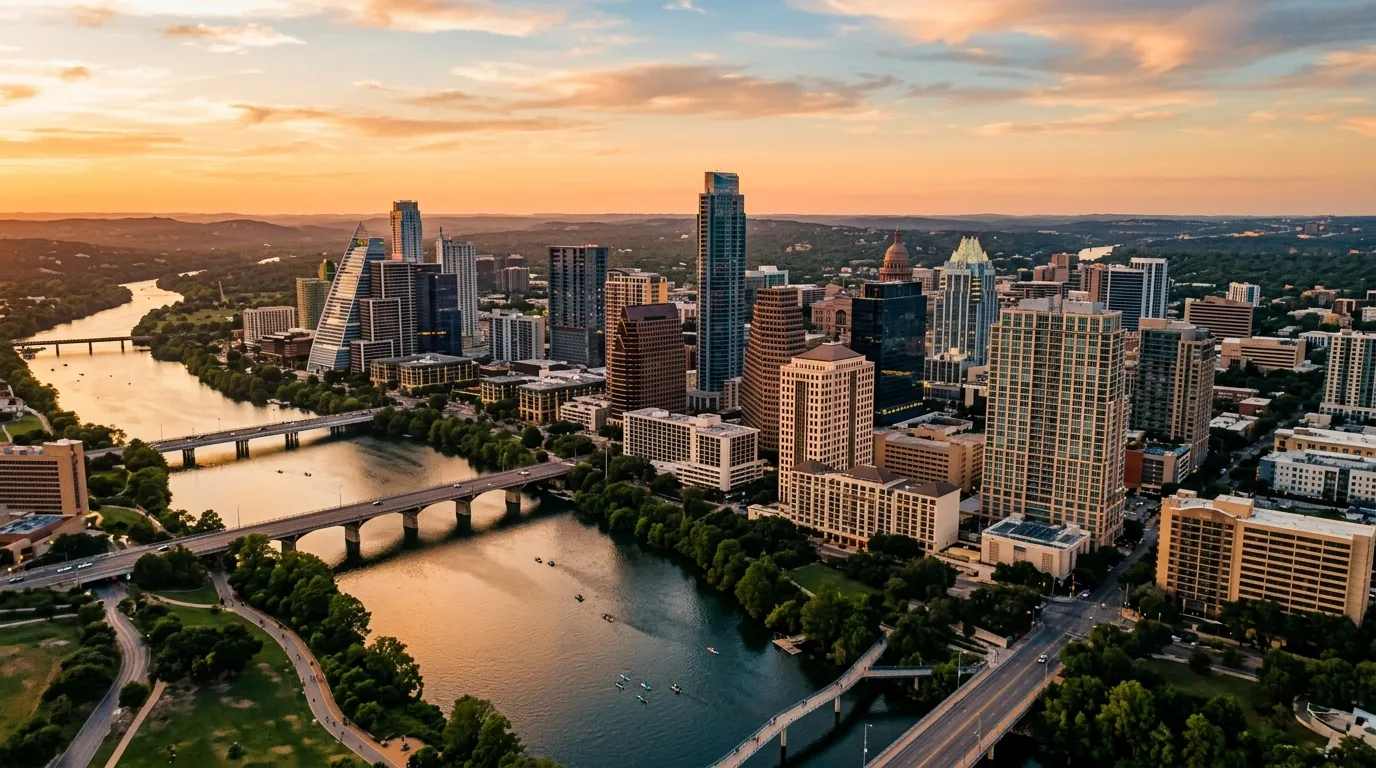
If you’re thinking about moving to Austin, Texas, you want more than a highlight reel. You want to know what it actually feels like to live here day to day — the weekends, the weekday commute, the food, the schools, the job market. After living in Austin for over a decade and helping dozens of families relocate here every year, here are the six reasons I recommend Austin to buyers who are on the fence.
I’m William Zhang, a local real estate agent with eXp Realty (TREC #811948). I help people move to Austin from California, Houston, Dallas, and out of state every month. This is the shortlist I give every client who asks, “What’s it really like to live in Austin?“
1. Austin Has the Best Nature of Any Major Texas City
This is the reason I stayed after college. I grew up in Houston and lived in Dallas for a year for work, and the difference is obvious the moment you drive into Austin. Houston and Dallas are flat — they’ve built outward across wide, open, featureless land. Austin is built into the Hill Country, wrapped around Lady Bird Lake, and bordered on the west by Lake Travis, one of the biggest lakes in Texas.
What that means in practice:
- Lady Bird Lake runs through downtown. In the summer I kayak and paddleboard here after work.
- McKinney Falls State Park is 20 minutes from downtown. In spring the Onion Creek Trail fills up with bluebonnets, the Texas state flower.
- Lake Travis on the west side has Hill Country views you don’t get anywhere else in Texas. Boating, cliff jumping, waterfront restaurants, the whole thing.
- Mount Bonnell and the parks along the Greenbelt give you hiking and rock climbing inside city limits.
If outdoor access matters to you, Austin is in a different league from Houston, Dallas, and San Antonio.
2. Events and Entertainment You Can’t Get Anywhere Else in Texas
Austin is called the Live Music Capital of the World, and it earns that label. Between SXSW, ACL (Austin City Limits), and the smaller festivals that run almost every weekend, there is always something happening. I volunteered at SXSW in college and got to experience the film, music, and education tracks for free — that kind of access is one of the reasons Austin attracts creative and tech talent.
Beyond the big festivals, you get tennis tournaments at the Austin Open in Westlake, Formula 1 at Circuit of the Americas, Oktoberfest celebrations, strawberry picking in the spring, pumpkin patches in October. The calendar is full year-round. If you’re someone who likes to have things to do on weekends, you won’t run out of options.
3. One of the Healthiest Cities in the Country
Austin consistently ranks as one of the healthiest cities in the U.S., and you feel it walking around. Everywhere you go, people are hiking, biking, running, or on their way to a workout. A few data points:
- Austin was ranked the #1 pickleball city in the U.S. in 2024.
- The Longhorn Run, Austin Marathon, and 3M Half Marathon draw thousands of local runners every year.
- Startup communities like Sweat Pals organize free yoga, bouldering, and run clubs almost daily.
If you’re moving from a less active city, this cultural difference is real. It’s easier to stay in shape in Austin because everyone around you is doing the same thing.
4. A Foodie Scene That Rivals Any Major U.S. City
Austin’s food scene has exploded over the last decade. When I first moved here, a dim sum restaurant was hard to find. Today there are full-service dim sum, authentic Sichuan, Korean BBQ, Japanese izakayas, Portuguese chicken spots like Nando’s, and of course the Texas BBQ Austin is famous for (Franklin, La Barbecue, Terry Black’s).
What makes Austin’s food scene different from Houston or Dallas is the density and diversity. You don’t have to drive 40 minutes across a sprawling metro to get good food — Austin’s food neighborhoods (East Austin, South Lamar, North Loop, Round Rock, Pflugerville) all have strong, walkable restaurant scenes of their own.
5. One of the Best Public School Systems in Texas
This is the reason most families I work with choose Austin over Dallas or Houston. The school quality in the Austin metro is genuinely elite.
- Eanes ISD (Westlake) is ranked the #1 public school district in Texas.
- LASA (Liberal Arts and Science Academy) is one of the top public high schools in the state.
- Lake Travis ISD, Leander ISD, and Round Rock ISD all have top-rated schools with strong test scores and college placement.
- The University of Texas at Austin is a top-tier public university with elite business (McCombs), engineering, and computer science programs.
Graduates from Eanes and LASA regularly go to Harvard, Princeton, Stanford, and MIT. UT Austin computer science grads start at Meta, Google, and Apple — many of them right here in Austin. If you’re moving with kids, school district should be the first filter you apply to neighborhoods. See my best neighborhoods for families in Austin guide for a breakdown of every top district.
6. A Tech and Business Job Market That Keeps Growing
Austin’s job market is the reason so many people are moving here from California and out of state. The big employers:
- Apple — a massive campus in North Austin
- Tesla — Gigafactory Texas and its new headquarters east of Austin
- Google, Meta, IBM, Oracle, Dell, Samsung, AMD, Nvidia — all have major Austin offices
- Indeed, Bumble, and dozens of venture-backed startups are headquartered here
This isn’t just about tech. Austin is the state capital of Texas, which means government jobs, healthcare systems (St. David’s, Ascension Seton), the University of Texas, and a growing finance and consulting sector. The economic base is diverse, the population is growing, and companies keep announcing new headquarters.
For buyers, this matters because job growth supports long-term home values. Austin has had corrections (we’re in one now), but the underlying fundamentals — jobs, population, quality of life — are still strong.
What Austin Isn’t
Nothing is perfect. Before you move, know the trade-offs:
- Summers are hot. June through September you’ll live between the AC and the pool.
- Traffic is bad. I-35 is the main north-south artery and it’s congested most of the day. Neighborhood choice is mostly about managing your commute.
- Home prices are higher than most of Texas. Austin is more expensive than Houston, Dallas, or San Antonio. You pay a premium for the lifestyle.
- Property taxes are high. Texas has no state income tax, but property taxes are 2-2.5% of assessed value. Factor this into your monthly payment.
If you want a fuller picture of the financial side, read my Austin vs Dallas cost of living comparison.
Where to Start Your Austin Move
If you’re seriously considering a move, the order of operations I recommend:
- Pick the right area first, not the house. The wrong suburb will make you regret the move even if the house is perfect. Start with my neighborhood guides.
- Get pre-approved with a local lender. Texas lending rules are different and local lenders understand our property tax situation.
- Plan a scouting trip. Spend 2-3 days driving the neighborhoods you’re considering. I run these for clients regularly.
- Work with a local agent. I’ve done this over a hundred times. I can save you from the mistakes I see relocation buyers make every month.
Austin isn’t the right fit for everyone. But if the six reasons above sound like the life you want, it’s worth a serious look.
If you want to talk through whether Austin is the right move for your family, reach out for a free relocation consultation. I’ll give you a straight answer — even if the answer is that another city might fit better. Call or text me at (512) 766-3188.
Frequently Asked Questions
Is it worth moving to Austin, Texas in 2026?
Austin remains one of the best U.S. cities to move to in 2026 if you value outdoor access, job growth, and top schools. The housing market has corrected from its 2022 peak, median home prices are around $489,000 in Travis County, and buyers have more leverage than they've had in years. It's worth the move if you plan to hold property for 5+ years and can tolerate hot summers and high property taxes.
What is the best school district in Austin, Texas?
Eanes ISD (which covers Westlake) is consistently ranked the #1 public school district in Texas. Lake Travis ISD, Leander ISD, and Round Rock ISD are the next tier and are all considered top districts in the Austin metro. LASA (Liberal Arts and Science Academy) is one of the best public high schools in the state and draws students from across the metro.
How much does it cost to live in Austin, Texas?
The median home price in Austin (Travis County) is around $489,000 as of early 2026. Property taxes run 2.0–2.5% of assessed value, which adds roughly $800–$1,000 per month to a $500,000 home. Austin has no state income tax, but overall cost of living is 10–15% higher than Houston, Dallas, or San Antonio. Expect to spend $2,100–$2,500 per month on a market-rate one-bedroom rental in the core.
Is Austin cheaper than California?
Yes, Austin is significantly cheaper than most California metros. A home in Austin that costs $500,000 would typically cost $900,000 to $1.5 million in Los Angeles, San Francisco, or San Diego. Austin has no state income tax (California's top rate is 13.3%), but Austin's property taxes are higher than California's Prop 13-capped rates. For most California buyers relocating to Austin, the net savings are substantial.
What are the biggest downsides of living in Austin?
The biggest downsides are hot summers (June–September regularly hit 100°F+), heavy I-35 traffic, high property taxes (2–2.5% of home value), and home prices that are higher than most of Texas. Allergies are also a known issue, especially from cedar trees in winter and oak pollen in spring.
What companies are hiring in Austin, Texas?
The major tech employers in Austin include Apple, Tesla, Google, Meta, IBM, Oracle, Dell, Samsung, AMD, Nvidia, Indeed, and Bumble. Dell is headquartered in Round Rock, Apple has a large North Austin campus, and Tesla has its headquarters and Gigafactory east of Austin. Outside of tech, the state of Texas, University of Texas, St. David's HealthCare, and Ascension Seton are the largest non-tech employers.
Is Austin a good place to live for families?
Yes. Austin consistently ranks as one of the best U.S. cities for families because of top-rated school districts (Eanes, Lake Travis, Leander, Round Rock), abundant parks and outdoor activities, safe suburban neighborhoods, and strong job growth. Suburbs like Cedar Park, Round Rock, Pflugerville, and Georgetown are especially popular with families relocating to Austin.
What is the best neighborhood in Austin for someone moving from out of state?
For most out-of-state relocation buyers, the best suburbs are Cedar Park and Round Rock (top schools, balanced cost), Pflugerville (affordability and tech commute), Leander (new construction value), and Lakeway (luxury Hill Country). The right choice depends on your commute, budget, and school needs — see my neighborhood guides for a full breakdown.
How hot are Austin summers really?
Austin summers are hot but not unbearable. June through September regularly hit 95–105°F, with July and August being the peak. Most homes have central AC and most neighborhoods have community pools. The heat is dry compared to Houston, which makes it more tolerable. Winters are mild — typically 50–65°F daytime highs in December and January.
Do I need a car in Austin, Texas?
Yes. Austin is a car-dependent city. Public transportation exists (CapMetro buses and the MetroRail from Leander to downtown) but it's not comprehensive enough for most daily needs. If you're moving to any suburb — Cedar Park, Round Rock, Pflugerville, Lakeway, Georgetown — you'll need at least one car, often two for a family.
Is Austin's housing market a good time to buy in 2026?
Yes, for most buyers. Austin is currently in a buyer's market with inventory above historic averages, median prices down about 13% from the 2022 peak, and sellers willing to negotiate on price, closing costs, and repairs. Interest rates remain elevated, but builders are offering rate buydowns on new construction. If you plan to hold property for 5+ years, 2026 is one of the best buying windows since 2019.
Have questions about Austin real estate?
Reach out — I'm happy to help with your home search or sale.