$500K Austin Home: Inside the City vs. the Suburbs
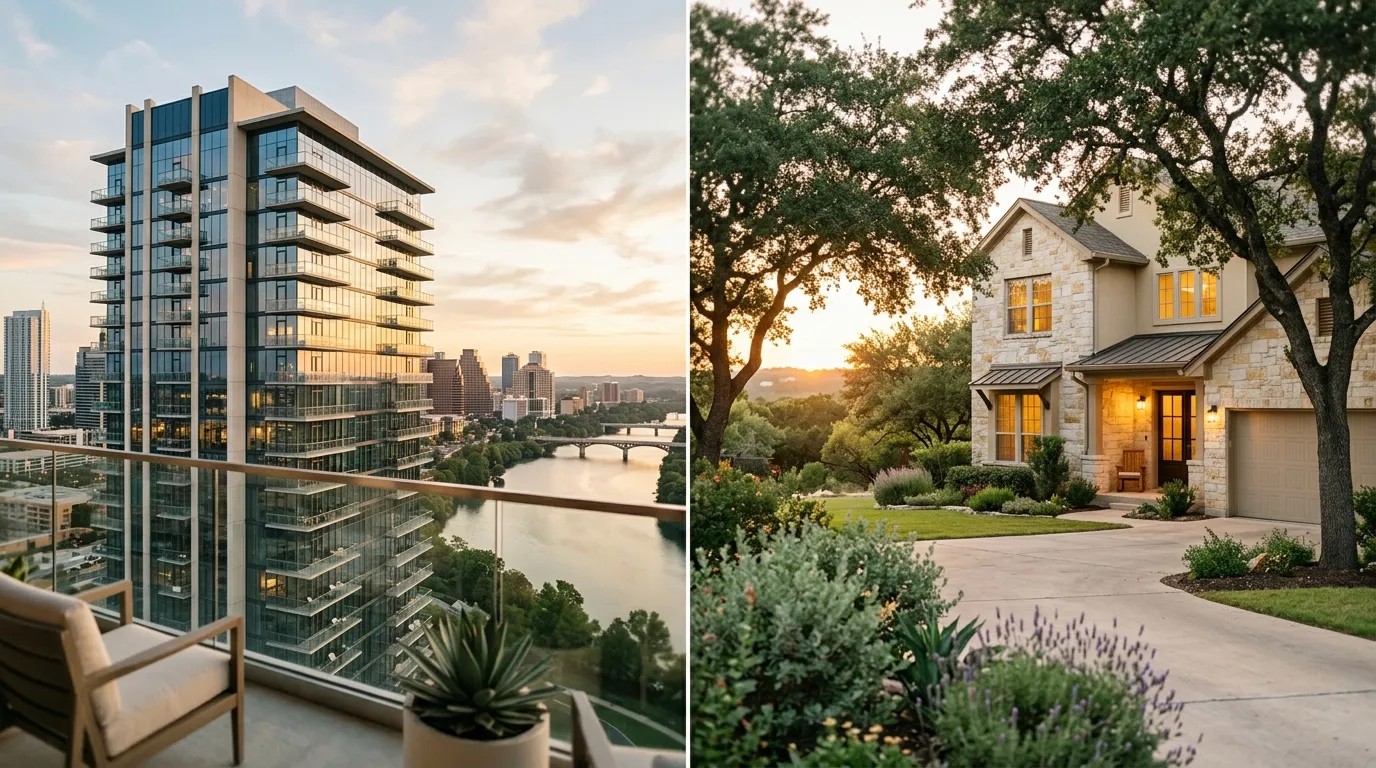
Five hundred thousand dollars in Austin buys two completely different lives depending on where you buy. Inside the city at that budget you get somewhere between 1,400 and 1,800 square feet — walkable, urban, close to everything Austin is known for. Thirty minutes north or south in the suburbs, that same $500K buys you 2,400–3,000 square feet of new construction, a three-car garage, and a school district that shows up on state rankings.
I’m William Zhang, a real estate agent with eXp Realty (TREC #811948), and I walked buyers through both sides of this comparison recently. The gap is not subtle. Here’s what the $500K Austin home inside vs. suburbs decision actually looks like in 2026.
Inside Austin at $500K: What You’re Actually Getting
The city side of this comparison has two flavors at $500K.
The first is a larger resale — something like 2,700–2,800 square feet in a neighborhood like North Austin’s 78750 or southeast Austin near 183. I walked a four-bedroom, three-bath home with nearly 2,800 square feet at this price point: stainless appliances, kitchen island, covered patio, and a fully fenced backyard. Fresh paint throughout, 100-day home warranty included. That’s more space than most people expect at $500K inside city limits.
The second flavor is the urban lock-and-leave. A three-bedroom, four-bath condo in central southeast Austin — 1,785 square feet, gated community, every bedroom en suite. Minutes from downtown South Congress, East Austin, and the airport. Champagne bronze fixtures, brass kitchen accents, quartz countertops, gas range, tankless water heater, included washer-dryer. The community has a dog park, picnic grounds, and bike lane access to Zilker Park and Lady Bird Lake about ten minutes away.
Both versions have genuine appeal. The condo is pure urban Austin lifestyle — you’re in the middle of everything, walking to restaurants and running trails. The larger resale gives you more space but comes with Austin’s perennial structural question.
The Two Risks Nobody Tells You About First
Clay soil and flood zones.
Austin’s expansive clay soil affects a significant number of homes inside city limits, particularly those built before 2000. When the soil swells and contracts with moisture, it moves foundations. Foundation repairs in Austin run $15,000–$40,000 depending on scope. That’s not a worst-case scenario — it’s a realistic cost on many older central Austin homes. A thorough inspection with a foundation specialist before closing is non-negotiable here.
Flood zones are the second issue. Central Austin has multiple creek systems and Colorado River tributaries that put a meaningful number of properties inside FEMA flood zones. Mandatory flood insurance in a Special Flood Hazard Area adds $1,200–$3,000 per year to your carrying costs — costs that don’t show up in the list price comparison but directly affect your monthly payment and resale pool.
Both of these factors are more prevalent inside the city than in newer suburban builds, where engineered foundations and graded lots are standard.
The Suburbs at $500K: Space, Schools, and Builder Math
The suburban side at $500K looks different. In Pflugerville, you’re looking at new construction with roughly 2,200 square feet — three bedrooms, main-floor primary suite, quartz counters, gas cooktop, electric fireplace, and $25,000 in builder incentives for closing costs or a rate buydown. Move in with as little as $1,000 earnest money on some of these deals.
In Georgetown, the same budget gets you four bedrooms, three baths, and around 2,580 square feet on a corner lot — directly across from an elementary school. Custom closets, kitchen island, flex room that works as an office or fifth bedroom, wired for sound. Well-located, practical, and large.
These aren’t cramped suburban starter homes. At $500K in the suburbs in 2026 you’re getting genuinely well-appointed construction with full builder warranties and none of the deferred maintenance exposure you carry with Austin resale.
The School District Reality
This is where the suburban math shifts decisively for families.
Leander ISD covers most of Cedar Park and Leander. It’s one of the top three school districts in Central Texas with Vandegrift High School ranked in the state’s top 15. Round Rock ISD (covering Round Rock and parts of Pflugerville) has Westwood High School in the state’s top ten. Georgetown ISD has been improving steadily.
Inside Austin, AISD covers most of the city. There are strong schools — LASA (Liberal Arts and Science Academy) is ranked third in the state — but LASA is a magnet school you have to apply for, not a neighborhood school. Zoned school quality in AISD is highly variable by address. Checking the exact attendance zone for any Austin address before you commit is essential.
For a deep dive on school district rankings across the Austin metro, see the top Austin school districts post.
How I Actually Think Through This Decision
If you’re a new hire who just relocated to Austin and you’re going into the office daily — say you’re heading to the Domain, the Samsung fab in Cedar Park, or Tesla in southeast Austin — then location relative to that commute should be your primary filter. A shorter daily commute compounds. Thirty minutes each way is 260 hours a year. That time has real value.
If you’re a couple planning for kids in the next few years, the math shifts toward the suburbs. School district quality, square footage, a backyard, a neighborhood where children can grow up — those start to win over walkability when you’re thinking three to five years out. And $500,000 in Leander or Pflugerville genuinely checks those boxes in a way that $500,000 inside Austin cannot.
There’s also a financial clarity issue worth being direct about. At $500K inside Austin, you’re often buying an older home with deferred maintenance. Foundation, plumbing, electrical, HVAC — older systems cost money. I’ve watched buyers go in excited about a “fixer-upper” and spend $30,000–$40,000 in the first year on systems the inspector flagged. That’s not a horror story, it’s a predictable outcome with 1980s construction.
Neither choice is wrong. But you need to go in clear-eyed about what the total cost of ownership looks like, not just the purchase price.
Commute Reality: The Number You Can’t Ignore
From inside Austin (southeast, central): 10–20 minutes to downtown on most routes.
From Pflugerville: 25–35 minutes via 130 or 183.
From Georgetown: 45–50 minutes to downtown, 30 minutes to the Domain.
From Leander (Cedar Park area): 25–30 minutes to the Domain, 40–45 minutes to downtown.
Test the actual commute at 8 AM on a Tuesday before you make an offer. Not at noon, not on a Sunday. The difference between a 25-minute commute and a 45-minute commute on paper is 170 hours per year in your car.
The Short Version
City at $500K: smaller, older, better location, more lifestyle. Real risks with clay soil and flood zones that require professional evaluation before closing.
Suburbs at $500K: bigger, newer, top-rated school districts, builder incentives that add $20,000–$25,000 in value. Commute is the cost.
The right answer depends on where you work, whether you have kids, and whether you’re optimizing for lifestyle today or equity over five years.
If you want to walk through both options in person, reach out — I can build a side-by-side comparison around your specific job location and school requirements. Current listings in both areas are searchable at lifeinaustintx.com.
For neighborhood context, the Cedar Park guide covers the northwest suburbs in detail, and the Pflugerville guide covers the northeast.
Frequently Asked Questions
What does $500K buy inside Austin city limits in 2026?
At $500K inside Austin, you're typically looking at 1,400–1,800 square feet in central or southeast Austin — either a mid-size resale home or a newer condo/townhome in a gated community. Finishes are often upgraded, walkability is excellent, and you're close to downtown, South Congress, and Lady Bird Lake. Square footage and lot size are the sacrifices.
What does $500K buy in Austin suburbs in 2026?
In Pflugerville, Leander, or Georgetown, $500K gets you 2,200–3,000 square feet of new or near-new construction — 3–4 bedrooms, 2–3 car garage, large backyard, and full community amenities. Builder incentives at this price point can add $25,000 in value through rate buydowns and closing cost credits.
Is it better to buy inside Austin or in the suburbs at $500K?
It depends on your stage of life. For new hires commuting to a specific employer, proximity matters more — stay closer to the city. For families planning ahead with kids, the suburbs win on school district quality, square footage, backyard, and long-term value per dollar. Both can be good decisions if you understand the trade-offs clearly.
What is the flood zone and clay soil risk for Austin homes?
Austin's clay soil is a real issue for older homes inside the city — it causes foundation movement that can cost $15,000–$40,000 to repair. Flood zones are also more common in central Austin near creeks and the Colorado River tributaries. Both issues require mandatory disclosure and can add significant costs. New construction in the suburbs typically has engineered foundations and sits outside FEMA flood zones.
Do Austin condos at $500K hold value as well as single-family homes?
Not historically. Austin condos have appreciated more slowly than single-family homes over the past decade, and HOA fees can add $300–$600 per month. At $500K, a condo inside Austin offers lifestyle and location but a single-family home in the suburbs typically builds equity faster. The right choice depends on whether you prioritize location or long-term wealth building.
Have questions about Austin real estate?
Reach out — I'm happy to help with your home search or sale.