Austin MUD vs PID Explained for New Construction Buyers
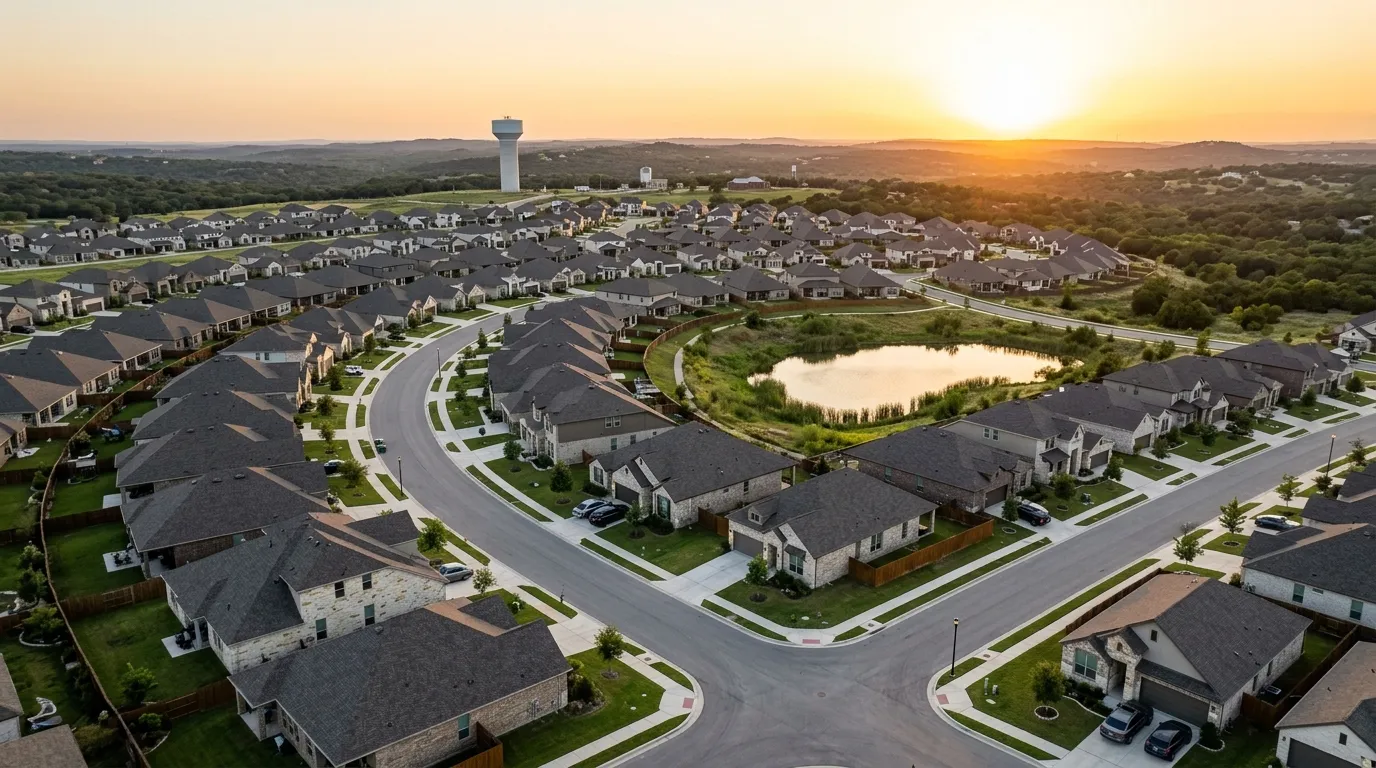
Bottom line: A Municipal Utility District (MUD) in the Austin metro typically adds $0.25 to $1.50 per $100 of value in property tax — $1,250 to $7,500 per year on a $500,000 home on top of standard taxes. A Public Improvement District (PID) often adds another $500 to $3,000 per year. Most new construction in Manor, Hutto, Liberty Hill, parts of Leander, Pflugerville, Kyle, and Buda is in a MUD or PID. The Texas homestead exemption usually does not apply to MUD taxes. Lenders include MUD taxes in your DTI calculation, which means a MUD home reduces how much house you qualify for. This is the single most common surprise for new construction buyers in the Austin metro, and it is verifiable in five minutes before you make an offer.
William Zhang is an Austin real estate agent with eXp Realty (TREC #811948) who has helped clients evaluate hundreds of new construction homes across the Austin metro. MUD and PID math is the single most underweighted variable in the new home search. This guide explains exactly how each works, how to verify status before you sign, and how to factor the additional cost into your purchase decision. For the broader picture, see the Austin new construction guide.
The Short Version
If you only have two minutes:
- MUD = Municipal Utility District. State-approved. Funds water, sewer, drainage, roads. Adds 0.25% to 1.50% to your property tax rate.
- PID = Public Improvement District. City-approved. Funds parks, trails, lighting, landscaping. Adds $500 to $3,000 per year, often as an annual fee.
- Where they exist: Most new construction in Manor, Hutto, Liberty Hill, parts of Leander, Pflugerville, Kyle, Buda, and Georgetown. Rare inside Austin city limits and in Bee Cave, Lakeway, Westlake.
- Verify: Search the parcel on TCAD (Travis), WCAD (Williamson), or HaysCAD (Hays). Check the “Taxing Jurisdictions” list.
- Homestead exemption: Usually does not apply to MUD taxes.
- Impact on financing: Reduces how much house you qualify for by $50K to $70K on average versus a non-MUD home.
- Duration: 20 to 40 years, though rates typically decline as bonds are paid off.
If you are looking at a $450K to $700K new construction home in Manor, Hutto, eastern Pflugerville, or Leander, assume MUD or PID applies and verify before earnest money goes hard.
What a MUD Actually Is
A Municipal Utility District is a special-purpose governmental entity that Texas allows developers to create when they are building in areas without existing public water, sewer, and drainage infrastructure. Think of a MUD as a mini-government for a single subdivision.
Here is how it works:
- A developer buys a 500-acre tract outside an established city utility service area — say, in unincorporated Manor.
- The developer applies to the Texas Commission on Environmental Quality (TCEQ) to create a MUD.
- Once approved, the MUD is a legal taxing entity. The developer (acting as the initial board) issues bonds — typically $20M to $60M — to fund construction of water, sewer, drainage, roads, and sometimes amenities like a pool or trail system.
- The bonds are repaid through a property tax levied on every home built inside the MUD’s boundaries. That tax is collected by the county tax collector along with your regular property tax bill.
- Over time, as homes sell and the MUD has enough resident homeowners, control of the MUD board transfers from the developer to elected homeowner representatives.
- MUD taxes continue until all bonds are retired — typically 20 to 40 years.
This is not a bad system. It is how a developer makes development possible in an area that would otherwise lack utilities. The cost of the infrastructure is real; the question is who pays it and how it shows up.
Without a MUD, the developer would need to pay for the infrastructure upfront and bake it into the price of each home — making the home cost $40,000 to $80,000 more at closing. With a MUD, the infrastructure cost is amortized across the bond term and shows up as an annual tax. Buyers often prefer this because their cash to close is lower, even though their lifetime cost is similar or slightly higher.
What a PID Actually Is
A Public Improvement District is similar to a MUD in that it is a special taxing entity funded by property owners inside a defined boundary. The differences:
- Created by cities or counties, not state TCEQ.
- Funds amenities and quality-of-life infrastructure: parks, trails, lighting, landscaping, streetscaping, sometimes parking structures.
- Assessments are often fixed dollar amounts rather than percentage tax rates.
- PIDs often have a defined repayment term of 20 to 30 years, after which the assessment ends.
A typical Austin-area PID might assess $1,200 per year on a single-family home for 25 years to fund a community park and trail system. Some PIDs structure the assessment as a lump-sum option (pay $20,000 upfront at closing to avoid the annual assessment). Most buyers take the annual structure.
PIDs are common in:
- Liberty Hill (several PIDs across new subdivisions).
- Parts of Leander and Cedar Park.
- Buda and Kyle.
- Some Georgetown and Round Rock developments.
Inside Austin city limits, PIDs exist but are less common. Established neighborhoods generally do not have them.
MUD and PID in the Austin Metro: Where They Are
This is not exhaustive — verify any specific property — but the general pattern in 2026:
| Area | MUD Likely? | PID Likely? | Notes |
|---|---|---|---|
| Inside Austin city limits | Rare | Rare | Established utilities and city services |
| Cedar Park | Some new subdivisions | Some new subdivisions | Mixed; verify |
| Round Rock | Some new subdivisions | Some new subdivisions | Established core has neither |
| Leander | Common in new construction | Some PIDs | Especially north Leander |
| Georgetown | Common in newer areas | Less common | Older Georgetown core has neither |
| Liberty Hill | Almost always | Common | Heavy MUD/PID overlay |
| Hutto | Almost always | Common | High effective rates common |
| Manor | Almost always | Some | Carillon and similar large new developments |
| Pflugerville (east) | Common | Some | Falcon Pointe, Sorento, etc. |
| Pflugerville (central) | Rare | Rare | Older core |
| Kyle | Common in new subdivisions | Some | Plum Creek, others |
| Buda | Common in new subdivisions | Some | Sunfield, others |
| Dripping Springs | Some | Less common | More custom builds |
| Bee Cave | Rare | Rare | Established with no major new MUD developments |
| Lakeway | Rare | Rare | Mostly established |
| Westlake | Rare | Rare | Built out |
How to Verify MUD or PID Status
Five-minute check before you make an offer:
-
Go to your county’s appraisal district website.
- Travis County: traviscad.org
- Williamson County: wcad.org
- Hays County: hayscad.org
-
Search by address or parcel ID.
-
Open the property’s detail page and find “Taxing Jurisdictions” (sometimes labeled “Taxing Entities”).
-
Look at the list. A typical in-Austin home shows: AISD, City of Austin, Travis County, ACC, Central Health — five entities. A MUD property will have one or more additional entries like “MUD #14” or “Northtown MUD” with their respective tax rates.
-
For PIDs, check the same list. PIDs sometimes appear, but assessments are sometimes structured as HOA-collected fees that do not show on TCAD. Ask the listing agent or builder directly for written PID disclosure.
If the property is in a MUD or PID, ask three follow-up questions:
- What is the current MUD tax rate? And what has the trend been over the last 5 years?
- What is the total combined effective tax rate (all entities, all rates)?
- Is there a PID assessment, and what is the annual amount? Are there any lump-sum options?
The seller’s disclosure is required to identify MUD membership in Texas, but in new construction the builder’s contract should disclose both MUD and PID. Read those sections carefully.
How MUD/PID Affects Your Mortgage Qualification
Your lender uses your projected monthly housing payment (PITI: principal, interest, taxes, insurance) to calculate your debt-to-income ratio. Higher property taxes mean higher PITI, which means lower qualifying ratio, which means lower maximum loan amount.
Real example. Two identical $500K homes:
- Home A: Inside Austin city limits. 2.07% combined tax rate. Annual taxes: $10,350. Monthly tax portion of PITI: $863.
- Home B: Manor MUD. 2.80% combined tax rate. Annual taxes: $14,000. Monthly tax portion of PITI: $1,167.
The $304/month difference in tax means:
- At a 43% DTI cap and an 80K annual income, the buyer qualifies for roughly $50,000 to $70,000 less house in the MUD home.
- Equivalently, with the same target monthly payment, a buyer can afford $50K to $70K more home in Home A than in Home B.
This is why MUD math matters at the qualification stage — not just after closing.
Builder Incentives and MUDs: The Real Trade-Off
Many Austin builders offer aggressive incentives — rate buydowns, closing credits, design upgrades — on homes in MUD communities. See the Austin new home builder incentives guide for the current landscape. Why? Because MUDs make the home harder to sell at the same price as a non-MUD comparable. Builders use incentives to bridge that gap.
The math you should run:
- Take the builder’s listed price.
- Add the present value of MUD taxes over 10 years (rough estimate: annual MUD tax × 8).
- Subtract the builder incentive value (rate buydown PV + closing credit + design upgrade).
- Compare that net to a non-MUD home at the same price point.
If the math works after the incentive, the MUD home can be a good deal — especially if you plan to live there 10+ years and the amenities (community pool, trails, schools funded by the MUD) matter to you. If the math does not work after the incentive, the MUD home is priced based on builder-financed financing, not real value.
Common scenario: a $480K Manor MUD home with a builder offering a $25K closing credit and a 4.99% rate buydown is roughly equivalent to a $510K non-MUD home with a market-rate mortgage. The MUD home is cheaper at closing; the non-MUD home is cheaper over 10 years.
When a MUD Home Is the Right Choice
MUD homes are often the best new construction value in the Austin metro for:
- First-time buyers maximizing builder incentives to keep cash to close low.
- Buyers planning to live in the home 7+ years, where MUD rates often decline over time as bonds are paid down.
- Families prioritizing new construction amenities — community pools, trails, parks, recreation centers — that the MUD funds.
- Buyers who have already maxed out qualifying in lower-tax areas and need the additional inventory MUDs provide.
- Buyers who can stomach higher carrying cost in exchange for newer, larger homes with builder warranties.
MUD homes are often the wrong choice for:
- Short-term holders (2 to 4 years) who will not amortize the MUD math.
- Buyers near DTI limits who would qualify for materially more home in a non-MUD area.
- Investors who cannot capture homestead protections and face full assessed value annually.
- Buyers focused on lifetime cost rather than monthly payment.
Common MUD/PID Mistakes Austin Buyers Make
- Trusting the builder’s monthly payment estimate, which sometimes uses a 1.8% generic tax rate instead of the actual MUD-inclusive 2.8%.
- Missing the PID disclosure because it is buried in HOA documents rather than the contract.
- Assuming the homestead exemption will apply to MUD taxes — it usually does not.
- Not asking about the MUD’s debt level, which predicts how long elevated rates will last.
- Comparing on listing price instead of on full monthly carrying cost.
- Skipping the TCAD/WCAD search during the option period.
- Underestimating the resale impact. When you sell, your buyer will run the same MUD math you should have run. Homes in heavy MUD areas often sit on market longer.
Frequently Asked Questions
Do MUD taxes go away when the bonds are paid off? Yes, eventually — but it can take 20 to 40 years, and many MUDs issue new bonds before old ones are paid down. Rates typically decline over time but rarely reach zero.
Can a MUD raise its tax rate? Yes, within statutory limits. MUD boards (controlled by homeowners after build-out) vote on the rate annually based on debt service requirements and operating budget.
What happens to MUD taxes if I refinance? Nothing. MUD taxes are property-based, not mortgage-based. Refinancing has no effect.
Is a MUD the same as an HOA? No. A MUD is a governmental taxing entity that funds infrastructure. An HOA is a private nonprofit that enforces covenants and may collect dues for amenities. A home can be in both — most MUD homes are also in an HOA.
Are MUD taxes deductible on federal income tax? Yes, they are property taxes and are deductible up to the federal SALT cap ($10,000 combined state and local taxes for most filers).
Can I appeal MUD taxes? You can protest your appraised value through the standard county appraisal district process, which reduces the value the MUD tax applies to. You generally cannot protest the MUD rate itself — that is set by the MUD board.
Do MUD homes appreciate slower than non-MUD homes? Mixed evidence. In hot markets, MUD homes appreciate similarly. In flat or down markets, MUD homes can lag because their higher carrying cost makes them less competitive at the same listing price. Buyer behavior in 2024-2026 has been more sensitive to MUD math than in the 2020-2022 boom.
Working With William Zhang
I run a full MUD/PID analysis on every new construction property my clients consider — pulling the TCAD/WCAD/HaysCAD parcel data, identifying MUD and PID assessments, calculating effective rate, and comparing total monthly cost against non-MUD alternatives. If you are considering Manor, Hutto, Leander, Liberty Hill, Pflugerville, Kyle, or Buda new construction, get this analysis before you sign anything.
Reach out at (512) 766-3188 or through the contact form. I work the full Austin metro at eXp Realty (TREC #811948).
Frequently Asked Questions
What is a MUD in Austin Texas?
A MUD (Municipal Utility District) is a state-approved special taxing entity that lets developers finance water, sewer, drainage, and road infrastructure in new subdivisions outside existing city utility service areas. The MUD issues bonds to pay for that infrastructure, then collects an annual tax from every homeowner inside the district to repay the bonds. MUD tax rates in the Austin metro typically run $0.25 to $1.50 per $100 of assessed value, adding $1,250 to $7,500 per year on a $500,000 home on top of standard property taxes.
What is a PID in Austin Texas?
A PID (Public Improvement District) is a city-created taxing entity that funds amenities like parks, trails, lighting, landscaping, and streetscaping in a new development. Unlike MUDs, which are state-approved and primarily fund utilities, PIDs are city-approved and fund quality-of-life improvements. PID assessments often show up as a fixed annual fee rather than a percentage tax rate, which means they do not always appear on a TCAD parcel search the same way MUD taxes do. PID assessments in the Austin area typically run $500 to $3,000 per year on a single-family home.
Which Austin-area cities have MUDs?
Most new construction in Manor, Hutto, Liberty Hill, eastern Pflugerville, and parts of Leander, Kyle, Buda, and Georgetown sits inside a MUD. Bee Cave, Lakeway, parts of Westlake, and much of central Austin are not in MUDs because they use established city utilities. Inside Austin city limits, MUDs are rare — most homes use Austin Water. The newer the subdivision and the further from established city infrastructure, the more likely it is in a MUD.
Does the Texas homestead exemption apply to MUD taxes?
Not usually. The Texas homestead exemption reduces school district taxes and sometimes city or county taxes, but MUDs are independent taxing entities and the standard homestead exemption does not generally apply to MUD taxes. Some MUDs offer their own optional homestead exemption — usually $5,000 to $25,000 — but you have to file with the MUD separately. Always verify with the specific MUD before assuming an exemption applies.
How long do MUD taxes last in Austin?
MUD taxes typically last 20 to 40 years — the term of the underlying bonds that funded the infrastructure. As bonds are paid off, the MUD tax rate usually declines, but new bonds are sometimes issued for additional infrastructure, which can extend the timeline. In some older Austin-area MUDs, rates have dropped from $1.00 to $0.30 per $100 over 15 years. Other MUDs maintain elevated rates much longer because the district takes on additional debt for expansion.
How do I check if an Austin home is in a MUD or PID?
Search the parcel on the appropriate appraisal district website — TCAD for Travis County, WCAD for Williamson, HaysCAD for Hays. Look at the 'Taxing Jurisdictions' list for the parcel. If a MUD is taxing the property, it will appear in that list with its current rate. PIDs sometimes appear there too, but PID assessments are sometimes structured as fees that show up only in the HOA disclosure or builder paperwork. Ask the builder or seller directly for written confirmation of MUD and PID status before signing a contract.
How do MUD taxes affect mortgage qualification?
Lenders include all property taxes in the PITI (principal, interest, taxes, insurance) calculation and use that monthly amount in your debt-to-income ratio. A MUD tax of $4,000 per year adds about $333 per month to your PITI. At a 43% DTI cap, that $333 reduces your maximum monthly housing payment by the same amount — which can mean qualifying for $50,000 to $70,000 less house at typical 2026 interest rates compared to an equivalent home outside a MUD.
Are homes in Austin MUDs worth buying?
Often yes — MUD homes are usually new construction with builder incentives, modern layouts, and access to amenities like pools and parks funded by the MUD. The trade-off is the higher carrying cost. Compare total monthly cost (PITI plus HOA) between similar homes in and out of a MUD. A $500K MUD home with a 2.8% effective tax rate plus $80 HOA may have the same monthly cost as a $560K non-MUD home with 2.0% taxes — if the MUD home appreciates the same percentage as the non-MUD home, the dollar gain is lower. This is the math new construction buyers should run before signing.
Have questions about Austin real estate?
Reach out — I'm happy to help with your home search or sale.