Austin Commute & Traffic Guide 2026: Times and Best Areas
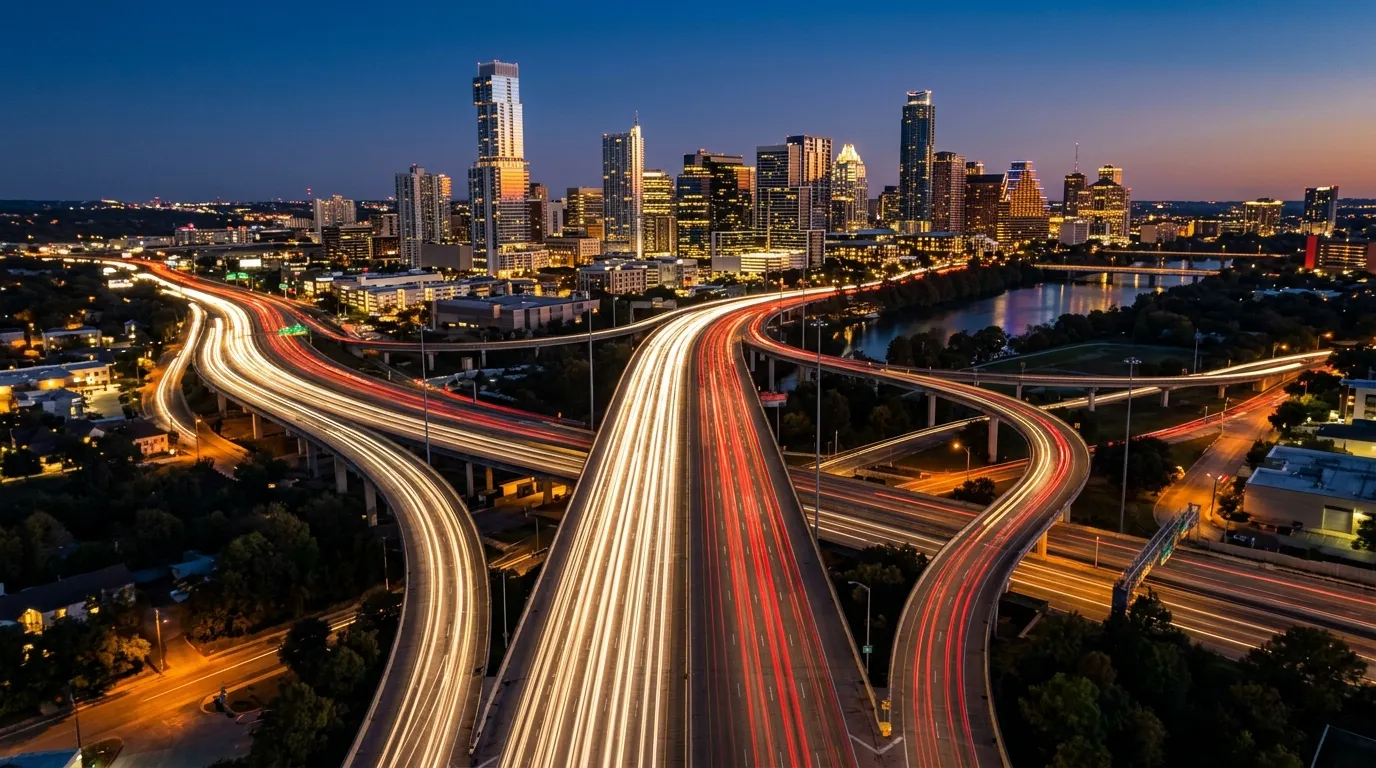
Bottom line: Austin’s traffic is concentrated on fewer highways than comparable metros, which makes peak rush hour feel worse than the metro size suggests. I-35 peaks 7:00-9:00 AM and 4:00-7:00 PM with chronic congestion through the central core. MoPac Express Lanes can save 15-25 minutes during peak. Average commute from suburbs to downtown is 35-60 minutes during peak; central Austin neighborhoods (Mueller, Hyde Park, Travis Heights, Bouldin, Tarrytown) commute downtown in 10-25 minutes. This guide covers rush hours, the worst bottlenecks, alternate routes, and where to live to minimize the traffic cost.
William Zhang is an Austin real estate agent with eXp Realty (TREC #811948). Commute is one of the biggest factors in where Austin clients decide to live — and one of the hardest to evaluate from outside the city. This guide reflects 2026 patterns based on lived experience and current INRIX/CapMetro data.
The Short Version
- Morning peak: 7:00 to 9:30 AM (worst 7:45-8:45)
- Evening peak: 4:00 to 7:00 PM (worst 5:00-6:30)
- Friday afternoon: starts by 3:00 PM
- Saturday morning: surprise congestion 10:00 AM to 1:00 PM
- Worst stretch: I-35 from Riverside to 183
- Fastest north-south option: MoPac with Express Lanes
- Best central commute neighborhoods: Mueller, Hyde Park, Travis Heights, Bouldin, Tarrytown, Crestview, Allandale
- Best suburban commutes: Westlake (MoPac), inner Round Rock (I-35), Cedar Park (MoPac or 183)
- Worst suburban commutes: Leander, Buda, Kyle, Hutto, Manor, Dripping Springs to downtown
Why Austin Traffic Feels Worse Than the Metro Size Suggests
Austin metro is about 2.5 million people in 2026 — roughly the same as Portland, Pittsburgh, or San Antonio. But Austin’s INRIX congestion ranking places it among the top 15 most-congested U.S. cities, well above metros of comparable size. Three structural reasons:
Limited east-west connectivity. The Colorado River cuts the metro east-west with limited crossings. Inside the city, Cesar Chavez, 1st Street, and 183 carry most of the east-west traffic. The South 1st bridge, Congress Avenue bridge, and South First Bridge are the only direct downtown crossings of Lady Bird Lake. One accident on any of these and the whole east-west flow stalls.
Funneled north-south traffic. Only three north-south options carry the entire metro’s commute: I-35 (the worst), MoPac (Loop 1, the fastest), and US 183 (good for west-central commutes). SH 130 toll road exists east of town but is rarely useful for typical commutes.
Highway capacity has lagged population growth. Austin metro added roughly 1 million people from 2010 to 2025. Major highway capacity additions in that window: a few miles of I-35 widening, MoPac Express Lane construction, and SH 130 build-out. Population grew faster than capacity.
The result is concentration: most metro commutes use the same three routes at the same times. Peak hour feels worse here than in Dallas or Houston because there are fewer alternate paths.
Austin’s Major Highways
I-35 (the main north-south spine). Runs from Round Rock south through downtown to Buda, Kyle, and beyond. Carries about 250,000 vehicles per day through downtown — the most-used highway in Austin. Chronic congestion through the central core (Riverside Drive to 183). Frontage roads are heavily congested as overflow. TxDOT’s I-35 Capital Express project is underway but not yet operational in 2026.
MoPac (Loop 1, the western alternative). Runs from northwest of the metro (Pickle Research Campus area) south to Slaughter Lane. The Express Lanes added in 2018 use dynamic tolls to maintain flow during peak hours — they can save 15 to 25 minutes during the worst rush hour. MoPac is the preferred north-south route for commutes that work for it.
US 183 (northeast-southwest). Carries traffic from Cedar Park and the Domain through Mueller and east Austin to the airport. Heavily used and often congested between Cedar Park and the Domain during peak.
SH 71 (west to airport). The main route from west Austin and the Hill Country to the airport. Peak congestion is bad in PM rush, especially Bee Cave to airport.
SH 130 (toll, eastern bypass). A toll road that goes from Georgetown south through Manor and to Mustang Ridge. Underused for typical commutes because it goes too far east. Useful for getting from north Austin to the airport in 35 to 40 minutes during peak — about half the time of I-35.
Loop 360 (Capital of Texas Highway). Connects northwest Austin to west Austin and 290. Scenic but slow during peak; mostly used by Westlake, Rollingwood, and Hill Country commuters.
RM 620 (around Lakeway). Major artery for the Lake Travis area. Heavy congestion during school start/end times and PM peak.
Rush Hour Patterns by Route
| Route | Morning Peak | Evening Peak | Notes |
|---|---|---|---|
| I-35 (northbound) | 6:45-9:30 | 3:30-7:00 | Worst stretch: Riverside to 183 |
| I-35 (southbound) | 7:00-9:00 | 4:00-7:30 | Worst stretch: Round Rock to 290 |
| MoPac (northbound) | 6:45-9:00 | 3:30-6:30 | Express Lanes available |
| MoPac (southbound) | 7:00-9:00 | 4:00-7:00 | Express Lanes available |
| US 183 (southeast) | 7:00-9:00 | 4:00-6:30 | Worst at Cedar Park to Domain |
| SH 71 (east toward airport) | 7:30-9:00 | 4:30-7:00 | Heavy PM peak |
| RM 620 | 7:00-8:30 (school) | 4:30-6:30 (school) | Worst at school start/end |
| Loop 360 | 7:00-9:00 | 4:30-7:00 | Slower north of 290 |
These are typical patterns. Special events (UT football, ACL Festival, SXSW, F1 weekend at COTA) extend and intensify peaks. Weekend traffic to Hill Country lake areas peaks Saturday 10:00 AM to 1:00 PM and returns 4:00 to 7:00 PM on Sundays.
The Worst Bottlenecks in Austin
In order of how often they ruin a commute:
- I-35 / Hwy 290 split in Round Rock (PM peak northbound). The split where I-35 and Hwy 290 separate is a chronic backup. Adds 15 to 30 minutes typical, 60+ on bad days.
- I-35 central core (Riverside to 183). Both directions, both peaks. Construction is making it worse through 2026.
- MoPac at 2222 (both peaks). Major merge with northbound traffic from west Austin.
- MoPac at 360 (both peaks). Hilly section with merge from Westlake.
- SH 71 from Bee Cave to airport (PM peak). Hill Country commuters returning home.
- William Cannon and Slaughter Lane exits on I-35 (PM peak southbound). Suburban commuters returning to south Austin.
- RM 620 around Lakeway (school start/end). Major congestion when Lake Travis ISD lets out.
- 183 north of the Domain (PM peak). Northbound traffic from central Austin returning to Cedar Park and Leander.
Best Alternate Routes (When Your Default Is Backed Up)
If I-35 northbound is backed up downtown, try:
- I-35 frontage road north
- East Frontage Road / Cesar Chavez east, then surface streets up
- SH 130 toll if you are going past Round Rock
If MoPac southbound is backed up, try:
- Express Lane (worth the toll during peak)
- Bull Creek Road / Burnet Road for north Austin destinations
- 360 if you are going to Westlake
If you are going to the airport during PM peak, try:
- SH 130 toll from north Austin (saves 20 to 30 minutes)
- Riverside east, then 71 east
If you are going from Cedar Park to downtown during peak, try:
- MoPac with Express Lane
- 183 if you have not had luck on MoPac
- 1431 east to I-35 (rarely worth it)
Best Neighborhoods to Commute From
| Neighborhood | Downtown peak commute | Domain peak commute | Airport peak commute |
|---|---|---|---|
| Mueller | 10-20 min | 20-30 min | 15-25 min |
| Hyde Park | 10-20 min | 15-25 min | 25-35 min |
| Tarrytown | 10-20 min | 20-30 min | 25-35 min |
| Travis Heights | 5-15 min | 20-30 min | 15-25 min |
| Bouldin | 10-20 min | 25-35 min | 15-25 min |
| Allandale | 15-25 min | 15-25 min | 30-40 min |
| Crestview | 15-25 min | 15-25 min | 30-40 min |
| North Loop | 15-25 min | 20-30 min | 25-35 min |
| East Austin (Cesar Chavez) | 5-15 min | 20-30 min | 15-25 min |
| Westlake | 15-25 min | 20-30 min | 25-35 min |
| Round Rock (inner) | 30-45 min | 20-30 min | 35-50 min |
| Cedar Park | 30-45 min | 20-30 min | 35-50 min |
| Pflugerville | 25-40 min | 15-25 min | 30-40 min |
| Lakeway | 30-50 min | 30-45 min | 30-45 min |
| Leander | 40-60 min | 25-35 min | 50-65 min |
| Buda | 30-50 min | 35-50 min | 25-35 min |
| Kyle | 35-55 min | 40-55 min | 30-40 min |
| Hutto | 35-55 min | 25-35 min | 45-60 min |
| Manor | 25-40 min | 25-35 min | 25-35 min |
| Dripping Springs | 40-60 min | 40-60 min | 35-50 min |
These are typical peak-hour times. Off-peak adds back 30 to 50% of the time. Special events and incidents can double these numbers.
If your work is in the Domain or northwest Austin, commute math flips entirely — Round Rock, Cedar Park, and Leander are short commutes; downtown-adjacent neighborhoods are long commutes. The Domain is one of Austin’s largest job centers and has reshaped commute patterns for thousands of workers since 2010.
If you work at Tesla Gigafactory in southeast Austin, your best commutes are from south Austin, Del Valle, or Bastrop — not from the urban core. Same logic for Samsung Taylor (north Austin, Round Rock, or Taylor) and the airport-adjacent employers.
How Many Cars and Where to Park
Most Austin households need at least one car. Walkable central Austin neighborhoods (Downtown, Mueller, Hyde Park, East Austin, Bouldin) can work with one car for a couple, especially with one remote worker. Suburban Austin generally requires two cars for two-earner households.
Downtown Austin parking has become genuinely expensive. Monthly garage rates run $200 to $350 in 2026. On-street parking is metered most places downtown. If you live downtown and work downtown, your car can sit unused for days at a time. If you live in a suburb and work downtown, your monthly parking cost is a real line item.
Most central Austin neighborhoods have street parking. Mueller, Hyde Park, Clarksville, and Travis Heights all have predominantly free residential street parking. East Austin has some parking pressure near commercial corridors.
CapMetro and Public Transit
Austin’s public transit is improving but limited:
MetroRail Red Line: Runs from Leander to downtown. About 18 to 25 trips per day, mostly commute-hour focused. Useful if your origin and destination both align with stations. Less useful for non-commute trips.
MetroRapid bus: High-frequency bus routes on Lamar (Route 801) and South Congress (Route 803). Functional for many in-Austin trips. Free for many users.
Standard CapMetro buses: Coverage is decent in central Austin, weak in the suburbs. Frequency varies widely.
Project Connect (future): Austin voters approved Project Connect in 2020 — a major light rail and BRT system. The Blue Line and Orange Line light rail are in design and construction, but not operational in 2026. Initial routes will run downtown to north Austin and downtown to south Austin. Estimated operational 2029-2033.
For most Austin commuters in 2026, transit is supplemental, not a replacement for a car. The exception is downtown-to-downtown commutes with MetroRapid, which work well.
Flex Hours and Hybrid Work
The biggest commute-reduction tool for most Austin workers is flex hours and hybrid scheduling. Even shifting commute by 30 minutes can cut peak time by 20 to 40%. Working from home 2-3 days per week eliminates that much of the commute time.
Tuesday through Thursday in-office, with Monday and Friday remote, has become the dominant tech pattern in Austin. This concentrates traffic on those three days and meaningfully eases Monday and Friday congestion.
Commute Considerations When House-Hunting
Three concrete questions to answer before buying:
-
Where exactly do you (and your spouse) work? Get the address. Plot it on a map. Now plot every candidate neighborhood and calculate the peak commute on Google Maps “depart at” 7:30 AM Tuesday. Compare.
-
What is your tolerance for commute hours per week? A 45-minute one-way commute is 7.5 hours per week, 30 hours per month, 360 hours per year — about 9 working weeks. A 20-minute one-way commute is 3.3 hours per week, 13 hours per month, 160 hours per year. The difference is roughly 200 hours per year — a full working month.
-
Is the commute reliable, or variable? Some routes (Westlake via MoPac) are predictable. Some (suburban Cedar Park or Lakeway) vary widely based on incidents and school traffic. Predictability often matters more than average time.
A common mistake is buying a house in a great-school suburb without testing the actual commute. Drive your candidate commute at the actual peak hour, in actual peak traffic, on a Tuesday or Wednesday, before you sign anything.
Working With William Zhang
When you tour homes with me, I include actual peak-hour commute tests as part of the search. We pick a Tuesday or Wednesday at 7:45 AM or 5:30 PM, drive your real commute from the candidate house, and you experience the trade-off in person before you make an offer.
Reach out at (512) 766-3188 or through the contact form. I work the full Austin metro at eXp Realty (TREC #811948).
Frequently Asked Questions
What are Austin rush hours in 2026?
Morning rush in Austin runs 7:00 to 9:30 AM, with the worst congestion between 7:45 and 8:45 AM on I-35, MoPac (Loop 1), US 183, and SH 71. Evening rush runs 4:00 to 7:00 PM, with peak congestion 5:00 to 6:30 PM. Friday afternoons start earlier — often by 3:00 PM. Saturday morning has surprise congestion 10:00 AM to 1:00 PM heading to lake areas, breakfast spots, and the Hill Country.
How long is the average commute in Austin?
Average one-way commute in Austin metro is 28 minutes in 2026 per Census ACS data. Inside Austin proper, average commute is about 22 minutes. From suburbs like Cedar Park, Round Rock, Leander, or Pflugerville to downtown, peak commutes typically run 35 to 60 minutes. Buda, Kyle, and Hutto run longer — 45 to 75 minutes. Tech corridor commutes (most people work in the Domain, Tesla Gigafactory, or downtown) can be lower because employees often choose to live near those clusters.
Is I-35 or MoPac faster in Austin?
MoPac (Loop 1) is usually faster than I-35 during peak hours, especially because MoPac added Express Lanes that use dynamic tolls to maintain flow. The Express Lanes can save 15 to 25 minutes during peak congestion. I-35 has no managed lanes and bottlenecks at the I-35/Highway 290 split, the central core, and the I-35/Hwy 71 interchange. For Austin commuters whose origin and destination both work for MoPac, it is the better default. For commutes east-west or to/from east Austin, I-35 is often the only practical option.
What are the worst traffic spots in Austin?
I-35 through the central core (Riverside Drive to 183) is the single worst stretch — chronic congestion in both directions. The I-35/Hwy 290 split in Round Rock backs up heavily during PM peak. MoPac near 360 and at the 2222 interchange. SH 71 from Bee Cave to the airport during evening peak. The William Cannon and Slaughter Lane exits on I-35 during PM peak. RM 620 around Lakeway during school start and end times.
Which Austin suburbs have the easiest commute downtown?
Mueller, Hyde Park, Allandale, Crestview, Brentwood, Travis Heights, Bouldin, and Zilker have the shortest practical commutes to downtown Austin — typically 10 to 20 minutes off-peak and 15 to 30 minutes during rush hour. South Lamar, North Loop, East Austin, and Tarrytown also commute well. From suburbs proper, Westlake (via MoPac), inner Round Rock (via I-35), and Cedar Park (via MoPac or 183) are the most workable suburban commutes. Further-out suburbs like Leander, Hutto, Manor, Buda, and Dripping Springs all face 45+ minute peak commutes downtown.
Is CapMetro a viable way to commute in Austin?
Limited. CapMetro's MetroRail runs from Leander to downtown with limited daily trips — generally 18 to 25 trips per day, mostly concentrated in commute hours. Bus service is decent in central Austin and weak in the suburbs. The MetroRapid bus on Lamar and South Congress is functional for in-Austin commutes. For most suburban commuters, driving remains the dominant practical option. Austin's planned Project Connect light rail expansion (Blue and Orange lines) is in development but not operational in 2026.
How bad is traffic in Austin compared to other cities?
INRIX 2025 data ranks Austin among the 15 most congested U.S. cities by hours lost per commuter, despite being smaller than most. Austin commuters lose roughly 80 to 100 hours per year to traffic versus 50 to 70 in comparable mid-sized cities. The reason: Austin's highway capacity has not kept pace with population growth, and limited east-west connectivity concentrates traffic on fewer routes than other metros with similar populations.
What is the best time to commute in Austin?
Before 6:45 AM or after 9:30 AM in the morning, and before 3:30 PM or after 7:00 PM in the evening. Tuesday through Thursday tends to be worse than Monday or Friday. Working-from-home Wednesdays and Fridays have noticeably eased peak congestion. If your job allows flex hours, shifting 30 minutes earlier or later can cut your commute by 20 to 40%.
Have questions about Austin real estate?
Reach out — I'm happy to help with your home search or sale.